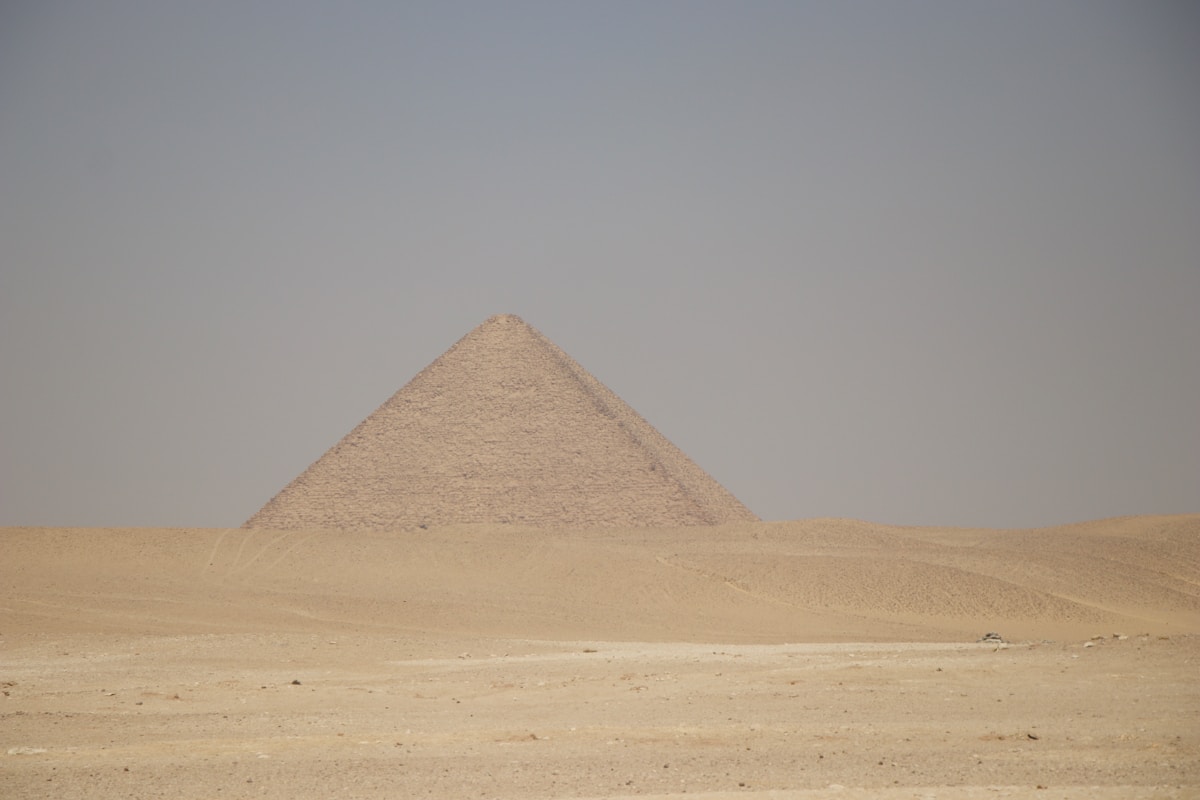
Twenty kilometres south of Saqqara, two massive Old Kingdom pyramids stand in open desert with almost nobody around. Dahshur is where King Sneferu - father of Khufu, builder of the Great Pyramid - worked out how to build a true pyramid, and his two surviving attempts are among the most important structures in architectural history. Combined with the ruins of Memphis, ancient Egypt’s first capital, they make the best half of a Cairo day trip that most visitors never take.
The Bent Pyramid: the experiment
Sneferu’s first Dahshur pyramid, built around 2600 BCE, started at a steep 54-degree angle. Partway up, cracks appeared - the foundation of desert clay could not take the load - and the builders reduced the angle to 43 degrees, giving the pyramid its distinctive bent profile.
The result is an accidental monument to trial and error, and it is remarkably well preserved: the Bent Pyramid retains more of its original smooth limestone casing than any other pyramid in Egypt. From a distance it looks closest to how all pyramids once looked. Interior access has been open since 2019 - a steep descent into two chambers with impressive corbelled ceilings - though it occasionally closes; your guide can confirm on the day. The small satellite pyramid beside it was likely for Sneferu’s ka (spirit).
The Red Pyramid: the solution
Having learned from the Bent Pyramid, Sneferu built again a kilometre north - this time at a constant 43 degrees. The Red Pyramid, named for the rusty limestone of its core, is the world’s first true smooth-sided pyramid and, at 105 metres, the third largest in Egypt after the two big pyramids at Giza.
You can go inside, and you should. The entrance is partway up the north face, reached by a staircase bolted to the casing. From there a passage 1.2 metres high descends 63 metres into the bedrock - you go down bent double, backwards is easiest, and your thighs will complain. At the bottom: three chambers with corbelled ceilings rising 15 metres, dimly lit, faintly smelling of ammonia, and frequently completely empty. Compare that to the queue and per-person surcharge inside the Great Pyramid. Wear shoes with grip and do not attempt it with knee problems or claustrophobia.
Where the Pyramids of Giza come with crowds, vendors, and camel touts, Dahshur is an active military-adjacent zone that only opened to tourists in 1996 - meaning open desert, silence, and a handful of other visitors even in high season.
Memphis: the vanished capital
Memphis was the capital of Egypt through the entire Old Kingdom - the administrative heart of the civilisation that built the pyramids. Almost nothing of the city survives above ground; its mudbrick dissolved and its stone was quarried for medieval Cairo. What remains is concentrated in an open-air museum in the village of Mit Rahina.
Two pieces justify the stop:
- The colossus of Ramses II - a 10-metre limestone statue of the pharaoh, lying on its back in a purpose-built viewing pavilion. The carving quality is extraordinary at close range: you can study the face, the cartouches, and the musculature from a raised gallery in a way no standing statue allows.
- The alabaster sphinx - at around 80 tonnes, the largest alabaster statue ever found, probably depicting Amenhotep II or Hatshepsut. It sits in the garden among column fragments, statuary, and the embalming tables of the sacred Apis bulls.
Allow 45 minutes to an hour. It is a modest site, but standing among the scraps of what was once the largest city on earth has its own weight.
Entry fees and opening hours as of 2026
| Site | Foreign adult fee | Hours |
|---|---|---|
| Dahshur (both pyramids + Red Pyramid interior) | approximately EGP 300 | 8am–5pm (4pm in winter) |
| Memphis open-air museum | approximately EGP 300 | 8am–5pm |
| Saqqara (if combining) | approximately EGP 600 | 8am–5pm |
Student discounts of roughly 50% apply with ISIC cards. Fees have risen sharply in recent years - treat these as guideline figures and verify current prices via the Ministry of Tourism and Antiquities or your guide before travelling.
How to visit: the classic Saqqara–Dahshur–Memphis day trip
The three sites line up south of Cairo and are almost always combined into one day, often called the “Memphis necropolis” circuit. A sensible order: leave Cairo by 8am, start at Saqqara (the Step Pyramid, the Serapeum, and the painted mastaba tombs deserve 2.5–3 hours), drive 20 minutes south to Dahshur, then stop at Memphis on the way back. You are back in Cairo by 4–5pm.
Transport options as of 2026:
- Private driver for the day - approximately USD 40–60 (around EGP 2,000–3,000) for the car, arranged through your hotel or a ride-hailing app’s hourly hire. Cheapest for a group, but you tour the sites unguided.
- Private guided tour - approximately USD 60–120 per person depending on group size, including an Egyptologist guide, vehicle, and hotel pickup. Worth it here: Saqqara and Dahshur reward explanation more than almost any sites in Egypt.
- Small-group tour - approximately USD 35–60 per person for a shared minibus version of the same circuit.
Search hotels in Cairo on Booking.com
There is no practical public transport to Dahshur. Entry fees and lunch are usually excluded from tour prices - confirm when booking.
Why go
Giza is unmissable, but it shows you the finished masterpiece without the working. Dahshur shows you the drafts - the bent experiment and the first true pyramid - in empty desert where you can hear the wind. Add the fallen colossus at Memphis and the painted tombs of Saqqara, and this day trip covers a thousand years of history with a fraction of the crowds. If you have two free days in Cairo, give one to Giza and the Egyptian Museum, and the other to this.
See also: Saqqara Step Pyramid | Pyramids of Giza | 3 Days in Cairo | Cairo and Giza day tours