Alexandria is not Luxor. There are no towering pylons or processional avenues. What the city has instead is a layered history - Greek, Roman, Jewish, early Christian, Byzantine, Arab - compressed into a modern Mediterranean port that looks more like Marseille than most visitors expect. The two sites covered in this guide sit at opposite ends of that timeline: the Catacombs of Kom el-Shoqafa represent the city’s Roman-era past, while the Bibliotheca Alexandrina is a 21st-century monument to the ancient city’s most famous institution.
The Catacombs of Kom el-Shoqafa
The Catacombs of Kom el-Shoqafa were discovered in 1900, reportedly when a donkey fell through the ground into the shaft entrance. They date to the 2nd century AD and represent the largest known Roman funerary complex in Egypt - a private tomb that was subsequently expanded and used by multiple families over several generations, eventually becoming a communal burial site that may have held hundreds of bodies.
The Architecture
The catacombs are entered through a rotunda at street level and descend via a spiral staircase cut into the rock. The staircase winds around a central shaft - the bodies of the deceased were lowered through this opening on ropes rather than carried down the steps.
The first accessible level below ground contains the Triclinium (banquet hall) where mourners held funeral meals. The room has carved stone couches along three walls - an arrangement directly derived from Roman dining culture. The combination of Egyptian funerary practices with Roman social customs is characteristic of the hybrid Alexandrian culture of the period.
Below the Triclinium, the second level contains the main tomb chamber - the most architecturally significant space in the complex. The entrance vestibule is flanked by two carved niches containing statues of the deceased in Egyptian priestly dress, but with distinctly Roman facial features. The carved relief decoration on the walls and the painted ceiling above the burial chamber blends Egyptian iconography (Anubis, the Eye of Horus, the winged sun disc) with Greek architectural details (pilasters, classical mouldings) in a synthesis that is uniquely Alexandrian.
The Hall of Caracalla on the same level contains a large number of disarticulated human and horse bones, believed to be the remains of Christians massacred under the Roman emperor Caracalla in 215 AD. The attribution is uncertain but the bone deposit is historically significant regardless of cause.
Visiting the Catacombs
The site is compact but the descent requires some care - the stone steps are worn and damp, and the lighting is moderate. Allow 45–60 minutes for a thorough visit. The catacombs are one of Alexandria’s most visited sites and can become crowded in the morning; arriving after 11am or in the early afternoon is generally more comfortable.
Entry costs approximately EGP 180 per person as of 2026. Opening hours are 9am to 5pm daily. Photography is permitted in most areas.
The catacombs are located in the Kom el-Shoqafa neighbourhood, about 2km south-west of central Alexandria. A taxi from the Corniche takes 10–15 minutes. On-site guides are available for hire at the entrance; a guided tour of approximately 45 minutes costs around EGP 100–150 as of 2026 - negotiable.
For a pre-arranged guided experience covering both the catacombs and the wider city, GetYourGuide offers vetted operators:
| Tour | Duration | Price (from) | Highlights |
|---|---|---|---|
| Alexandria Day Trip from Cairo with Catacombs | Full day | from $40 | Train or AC transport, catacombs, Bibliotheca, Corniche, licensed guide |
| Alexandria Half-Day Catacombs & Pompey’s Pillar Tour | 4 hrs | from $28 | Kom el-Shoqafa, Pompey’s Pillar, Serapeum site, English guide |
| Private Alexandria Historical Tour from Cairo | Full day | from $75 | Catacombs, Bibliotheca, Qaitbay Citadel, flexible pace, private guide |
Browse all Alexandria tours → GetYourGuide
Pompey’s Pillar
A short walk from the catacombs (5 minutes on foot) stands Pompey’s Pillar - a single red granite column 27 metres high, the tallest ancient monolith in Egypt outside Luxor and Karnak. Despite the name, it has nothing to do with Pompey; it was erected in 297 AD in honour of the Roman emperor Diocletian. Two sphinxes from the original Serapeum complex flank the column. Entry to the column’s precinct is included with the catacomb ticket, or purchasable separately for approximately EGP 80 as of 2026.
The Bibliotheca Alexandrina
The ancient Library of Alexandria was one of the largest and most significant centres of scholarship in the ancient world, founded under Ptolemy I in the 3rd century BC and gradually accumulating a collection estimated at hundreds of thousands of scrolls. Its destruction - gradual rather than a single catastrophic event - occurred over several centuries through war, fire, and institutional decline.
The modern Bibliotheca Alexandrina is not a reconstruction. It is a purpose-built research and cultural complex completed in 2002, designed by Norwegian architects Snøhetta in collaboration with Egyptian designers. The primary reading room is housed under a tilted circular roof - resembling a partial sun disc emerging from the ground - with a facade of Aswan granite carved with letters from over 120 world writing systems.
What to See Inside
The main reading room is the primary draw: a vast cascading space on multiple levels under a skylit roof, designed to suggest the famous ancient library while operating as a modern working institution. It is one of the most architecturally impressive interiors in Egypt. Visitors are permitted in the reading room during opening hours.
The Antiquities Museum in the basement displays objects excavated from Alexandria and the surrounding region - including coins, sculpture, and everyday items from the Ptolemaic and Roman periods. Entry to the museum is separate from the library.
The Manuscripts Museum holds copies and facsimiles of important historical manuscripts, including religious texts and scientific documents related to Alexandria’s intellectual history.
The Planetarium runs regular shows; check the schedule at the entrance or online. Separate ticket required.
Entry Fees and Hours at the Bibliotheca
General admission to the Bibliotheca Alexandrina costs approximately EGP 70 per person as of 2026, covering the reading room and the main exhibitions. Museum tickets are additional (approximately EGP 50 per museum). Opening hours are 10am to 7pm Saturday through Thursday; the library is closed on Fridays. Guided tours in English are available on request; enquire at the information desk.
Getting from Cairo to Alexandria
Train (recommended): High-speed Intercity trains depart Cairo Ramses Station for Alexandria Misr Station several times daily. Journey time is approximately 2 hours. First-class fares run approximately EGP 110–150 as of 2026; second-class approximately EGP 60–80. Book tickets at Ramses Station or via the Egyptian National Railways app. The train is the most comfortable and reliable option.
Bus: West Delta Bus Company operates frequent services from Cairo Turgoman Bus Station to Alexandria’s Moharam Bek Station. Journey time is 2.5–3 hours depending on traffic. Fares are approximately EGP 60–100 as of 2026. Air-conditioned coaches are comfortable; book online or at the station.
By car / taxi: The desert highway (Desert Road) between Cairo and Alexandria covers approximately 220km and takes 2.5–3 hours by car in light traffic. A private transfer from Cairo to Alexandria costs approximately EGP 1,500–2,500 as of 2026 depending on vehicle and operator. For a private door-to-door transfer, Kiwitaxi and similar operators offer fixed-price bookings with no metre anxiety.
Organising Your Day in Alexandria
A practical one-day itinerary from Cairo:
- Morning: Train from Cairo (depart 7–8am), arrive Alexandria by 10am
- Late morning: Catacombs of Kom el-Shoqafa + Pompey’s Pillar (2–2.5 hours)
- Lunch: Seafood on the Corniche - restaurants along the seafront between the Eastern Harbour and Shatby are significantly cheaper and more authentic than those in tourist-facing areas
- Afternoon: Bibliotheca Alexandrina + Corniche walk (2–3 hours)
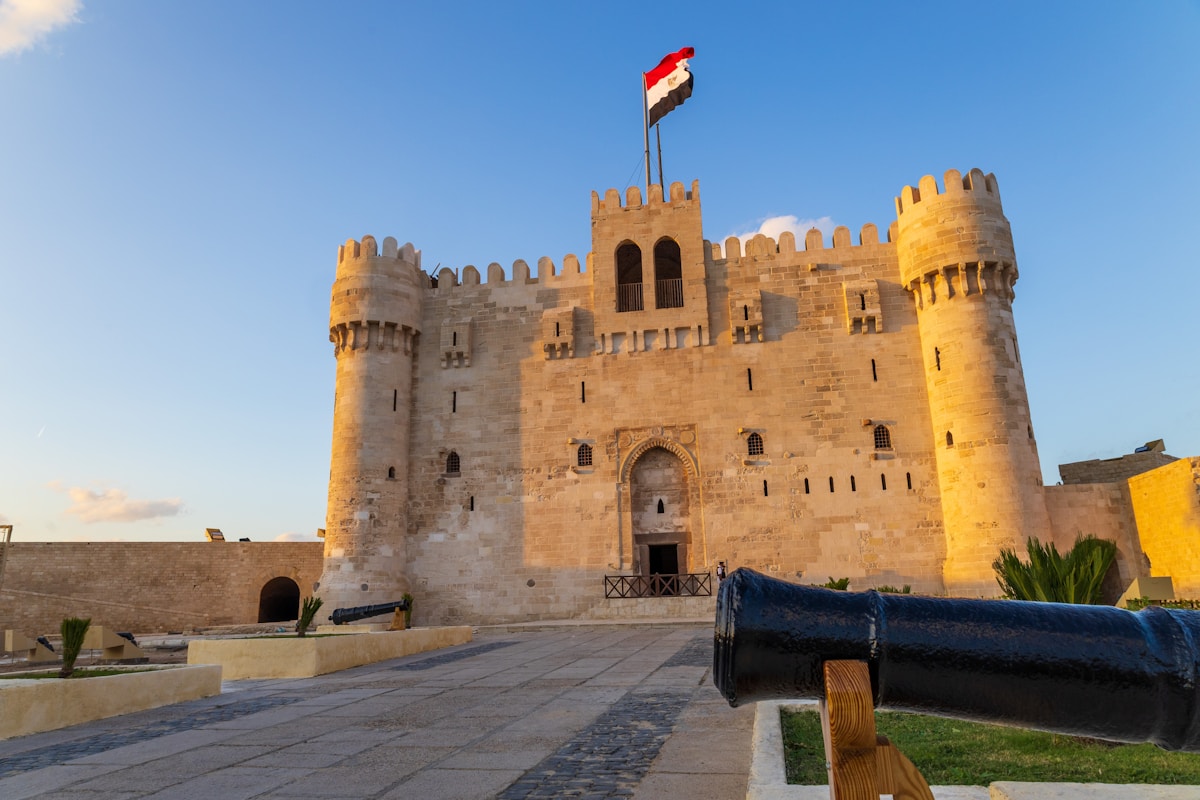
- Optional: Qaitbay Citadel (late afternoon, 1 hour) - a 15th-century Mamluk fortress built on the site of the ancient Pharos lighthouse, EGP 60 entry as of 2026
- Evening: Return train to Cairo
For full coverage of Alexandria - including where to stay, the best seafood restaurants, and the Eastern Harbour area - see our Alexandria city guide.
See Also
- Coptic Cairo - early Christian history in Egypt’s capital
- Islamic Cairo - medieval mosques, madrasas, and markets
Search hotels in Alexandria on Booking.com
- Egyptian Museum Cairo - the world’s largest collection of ancient Egyptian artefacts
- Ancient Egypt History Overview - context for Alexandria’s role in the later Egyptian story