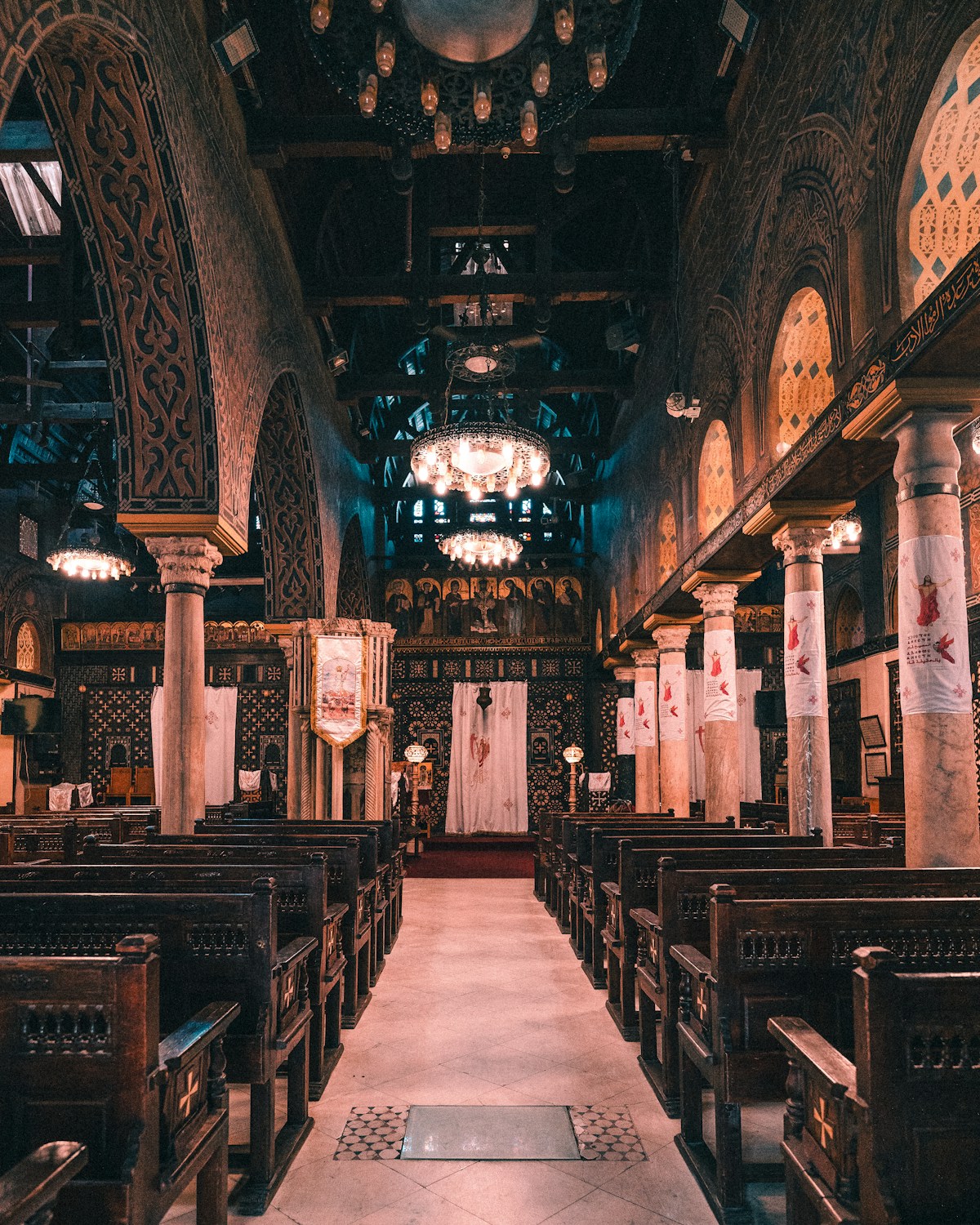
Coptic Cairo is a walled district in the southern part of the city, accessible in ten minutes from central Cairo by metro. It contains Egypt’s oldest surviving Christian churches, the Coptic Museum, and a historic synagogue - a combination that makes it one of the densest concentrations of pre-Islamic religious heritage in the Middle East. The district is compact enough to cover thoroughly on foot in a morning.
Coptic Christianity in Egypt
Coptic Christianity is Egypt’s indigenous Christian church. According to tradition, it was founded by the apostle Mark in Alexandria around 42 AD - several decades before Christianity reached most of Western Europe. The Egyptian church predates the Islamic conquest of Egypt in 639–642 AD by six centuries. Today, Coptic Christians make up approximately 10% of Egypt’s population, making Egypt’s Christian community one of the largest in the Middle East and Africa.
The Hanging Church (Al-Mo’allaqa)
The Hanging Church is the most visited site in the district and takes its name from its position suspended over a Roman gate tower - the nave is built above the tower’s two round turrets, which are visible in the church’s undercroft. The church’s origins are debated; some accounts trace a structure on the site to the 3rd or 4th century, with the current building substantially rebuilt in later centuries. It remains an active place of Coptic worship, with services held regularly. Visitors are welcome outside service times; modest dress is required.
Church of St Sergius and Bacchus (Abu Serga)
Abu Serga is one of the oldest churches in Cairo and is associated by tradition with the Flight into Egypt - the account in which Mary, Joseph, and the infant Jesus fled to Egypt from Herod. The church’s crypt, reachable by stairs, is traditionally identified as the site where the Holy Family sheltered. The crypt dates to at least the 4th century. Whether or not the tradition is historically accurate, it has made this church a pilgrimage destination for Coptic Christians for well over a millennium.
Ben Ezra Synagogue
The Ben Ezra Synagogue sits within the same walled enclosure as the Coptic churches. It is the oldest synagogue in Cairo and is associated by tradition with the prophet Jeremiah. The structure was substantially renovated in the 19th century and is no longer an active synagogue - Egypt’s Jewish community has almost entirely emigrated over the past century. It is maintained as a historic site and is open to visitors. The synagogue became significant to historians in 1896 when a large cache of medieval Jewish documents was discovered in its geniza (document storage room); these Cairo Geniza documents, now held in Cambridge and other archives, transformed the study of medieval Mediterranean history.
The Coptic Museum
The Coptic Museum, founded in 1908, holds the largest collection of Coptic art in the world. Its holdings span the 1st through 19th centuries and include illuminated manuscripts, textiles, carved woodwork, metalwork, and icons. The collection documents the evolution of artistic traditions from the late pharaonic period through the Islamic conquest and into the medieval era, making it useful context for visitors who want to understand Egyptian culture beyond the pharaonic period.
Getting There
The Metro is the most practical option: Line 1 (Helwan direction) to Mar Girgis station. The walled Coptic compound entrance is a five-minute walk from the station. The district is south of Downtown Cairo - too far to walk comfortably from Tahrir Square but a short taxi or metro ride.
The area pairs naturally with Islamic Cairo - the two districts cover Egypt’s Christian and medieval Islamic heritage in a single day. The Egyptian Museum at Tahrir is a short metro ride away and makes a natural afternoon addition. For the full Cairo picture including accommodation and day-trip logistics, see the Cairo city guide.
Search hotels in Cairo on Booking.com
See Also
- Things to Do in Cairo - how Coptic Cairo fits into a wider Cairo visit
- 3 Days in Cairo Itinerary - day-by-day plan that includes Coptic Cairo
- Cairo History - the broader narrative of Cairo across all periods
- Ancient Egypt History Overview - the pharaonic background that preceded Egypt’s Christian era
- Cairo tours and walking tours - browse guided Coptic Cairo and Islamic Cairo walking tours