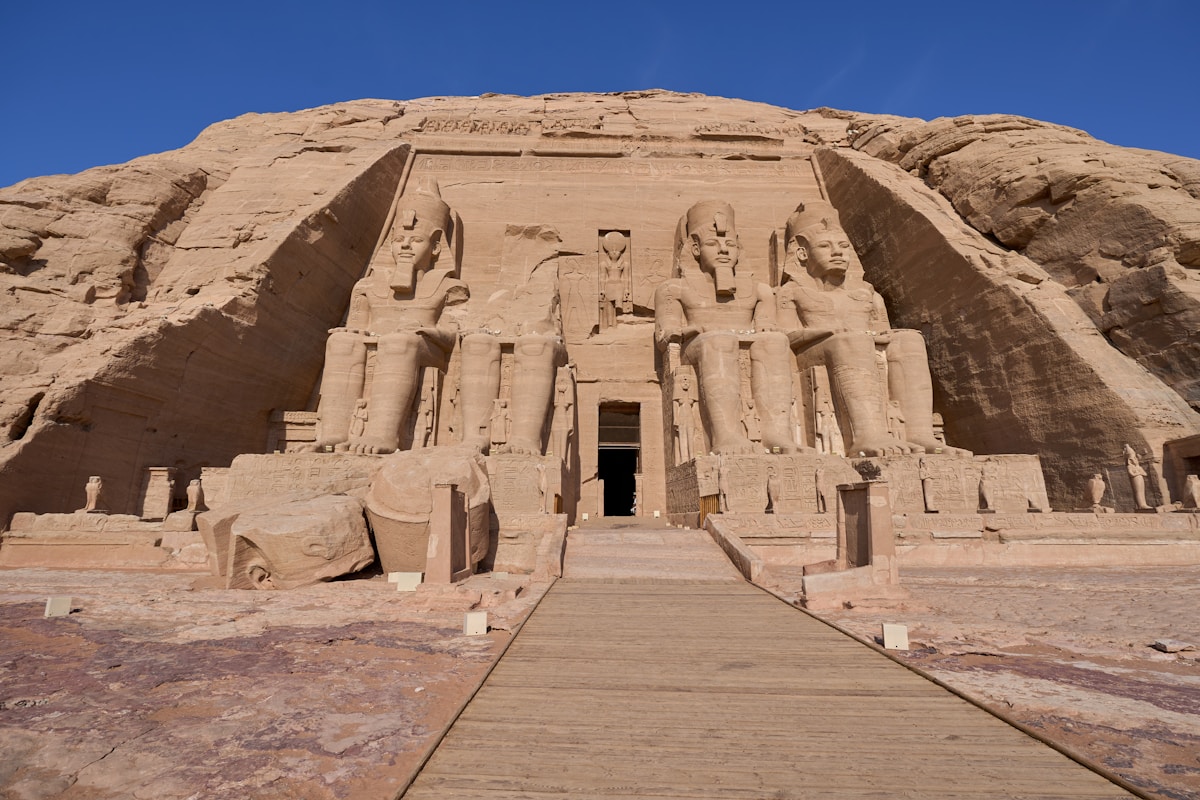
Abu Simbel sits 280km south of Aswan, close to Egypt’s border with Sudan on the western shore of Lake Nasser. The site contains two rock-cut temples commissioned by Ramesses II around 1264 BC. They are among the most technically impressive monuments in Egypt, and their twentieth-century relocation is itself one of the more extraordinary feats of modern engineering.
The Great Temple
The facade of the Great Temple is defined by four seated colossal statues of Ramesses II, each standing approximately 20 metres tall. One of the four was damaged in an ancient earthquake; the upper body collapsed and was not reconstructed during the UNESCO relocation in the 1960s. This damage is visible in the original ancient records and was not caused by the relocation work.
Inside, the temple descends through a series of pillared halls decorated with reliefs depicting the Battle of Kadesh (c.1274 BC) against the Hittites. The Egyptian account presents this as a decisive victory for Ramesses; the Hittite records and modern analysis suggest it was more likely a tactical draw followed by the world’s earliest known peace treaty. The inner sanctuary contains four seated statues: Ramesses II alongside Ra-Horakhty, Amun, and Ptah.
The Small Temple
The Small Temple, 150 metres to the north, was dedicated to Ramesses II’s principal wife Nefertari and the goddess Hathor. Its facade shows six standing colossal statues - four of Ramesses, two of Nefertari - with Nefertari depicted at the same scale as the pharaoh, which is unusual in Egyptian monumental art where queens were typically shown at a much smaller scale than the ruler. This is understood as a mark of exceptional status granted to Nefertari.
The UNESCO Relocation
When the Aswan High Dam was approved in the 1960s, rising waters from the newly created Lake Nasser threatened dozens of Nubian monuments. Abu Simbel was the most significant. Between 1964 and 1968, a UNESCO-coordinated international campaign cut both temples into approximately 1,050 numbered sandstone blocks weighing up to 20 tonnes each, transported them, and reassembled them on an artificial hill 65 metres higher and 200 metres inland from the original site. The estimated cost was $40 million USD. Concrete domes were constructed behind the new cliff face to simulate the mountain structure and support the relocated stonework.
The solar alignment was preserved during the relocation: the original 22 February and 22 October dates still work, shifted by one day from the probable original alignment dates as a result of the move.
The Solar Alignment
On 22 February and 22 October each year, the rising sun penetrates the 60-metre-long main axis of the temple and illuminates the sanctuary statues for approximately 20 minutes. Three of the four statues are lit; Ptah, god of the underworld, remains in shadow by design. The phenomenon draws large crowds; if your visit coincides with these dates, book transport well in advance.
Getting There from Aswan
Three options exist: road, flight, and Lake Nasser cruise.
The road is 280km and takes around 3.5 hours each way. Vehicles depart Aswan in a convoy at approximately 4am for security reasons; the schedule means a very early start and a significant portion of the day consumed in transit. Returning, the convoy departs Abu Simbel around midday.
The flight from Aswan Airport takes 45 minutes. Air Egypt operates scheduled services; charter services also run. The flight costs more but allows a full morning at the site and a return before early afternoon.
A Lake Nasser cruise typically takes 2–4 days departing Aswan, stopping at several Nubian temples before reaching Abu Simbel. This is the most contextually rich option for visitors with time.
See Also
- Abu Simbel travel guide - the full visitor guide covering accommodation, the sun festival, and all transport options
- Aswan travel guide - the natural base for an Abu Simbel visit, with its own temples, Nubian villages, and felucca routes
- Egypt Nile cruise itinerary - Abu Simbel as the southern anchor of a full Nile cruise holiday
- Abu Simbel tours from Aswan - browse guided day trips including transport and site entrance