Every Nile cruise between Luxor and Aswan is one of two products: a standard motorised cruise ship carrying 150–300 passengers, or a dahabiya - a traditional twin-masted sailing boat carrying 8–12. They follow the same river but deliver completely different trips, at completely different prices. This guide covers the practical differences so you can pick the right one before looking at specific boats or dates.
What is a dahabiya?
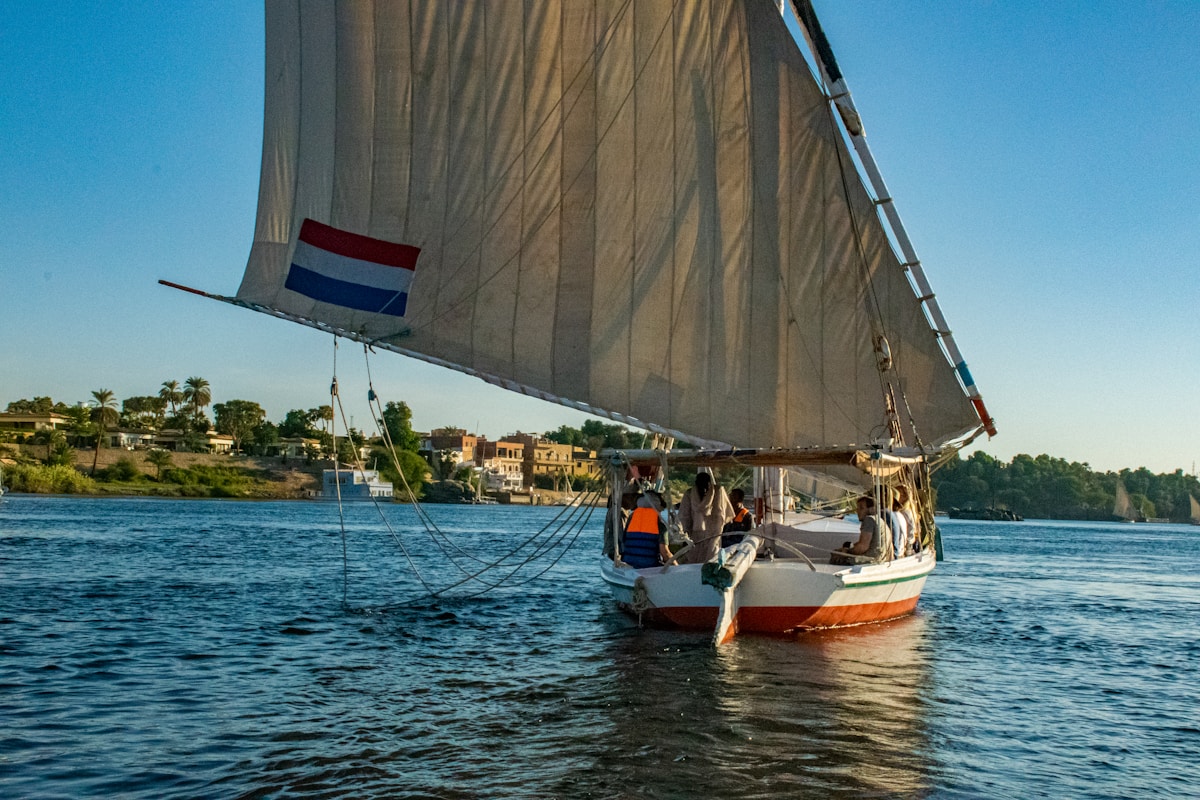
A dahabiya is a shallow-draft sailing barge with two lateen sails, a flat sun deck, and typically 5–6 cabins. The design dates to the 19th century, when wealthy travellers chartered them for months-long Nile journeys. Modern versions are boutique hotels in miniature: en-suite cabins, a chef on board, and a crew of 8–10 for as few as 10 guests.
Because dahabiyas have no engine for primary propulsion (a small tug assists when the wind drops), they move slowly and quietly. That slowness is the product - you watch the riverbank pass at walking pace, moor at islands for lunch, and hear nothing but water and birdsong.
A standard Nile cruiser, by contrast, is a floating hotel: 4–5 decks, a pool, a buffet restaurant, evening entertainment, and engine noise. It is comfortable and efficient, and it is how the overwhelming majority of visitors do the classic Nile cruise route.
Price comparison as of 2026
| Dahabiya | Standard cruise | |
|---|---|---|
| Per person per night | approximately USD 150–400+ | approximately USD 70–150 |
| Typical trip length | 4–6 nights | 3–4 nights |
| Total per person | from around USD 700, commonly USD 1,200–2,400 | approximately USD 250–600 |
| Group size | 8–12 passengers | 150–300 passengers |
Prices vary widely with season and cabin category - December–January and Easter command premiums, while May–September discounts can be steep. Standard cruises at the bottom of the range (around USD 70–80 per night as of 2026) usually show their age; mid-range ships at USD 100–130 are the sweet spot. Entry fees to temples are typically included on dahabiyas and often excluded on cheaper standard cruises - check before comparing totals.
The itineraries are genuinely different
Both boat types visit the headline temples: Edfu and Kom Ombo, with Karnak and Luxor Temple covered before departure and Philae after arrival in Aswan.
The dahabiya difference is everything in between. Shallow draft means dahabiyas moor where big ships cannot:
- Gebel el-Silsila - sandstone quarries where the stone for Karnak and Luxor Temple was cut, with rock-cut shrines along the riverbank. Standard cruises sail straight past.
- El Kab - one of Egypt’s oldest settlements, with painted nobles’ tombs and almost no other visitors.
- Esna Temple - its restored polychrome ceiling is among the best colour in Egypt; some standard cruises include it, many skip it because of the lock queue.
- River islands - lunch stops, swimming spots (in cooler months), and small farming villages.
You also visit Edfu and Kom Ombo at off-peak hours. Dahabiyas time arrivals for when the cruise-ship convoys have left, so you may share Kom Ombo with twenty people instead of two thousand.
Pace and atmosphere
A standard cruise runs on a schedule: wake-up calls, group disembarkation, guides with numbered paddles, buffet sittings. It is efficient - you see a lot in 3–4 nights - but you are moving with the convoy, and every site is busiest exactly when you are there.
A dahabiya has one guide for the whole boat, no queues, and a flexible rhythm. Meals are cooked to order, often featuring vegetables bought from riverside farmers en route. Evenings are quiet: no disco, no shows. Some travellers find this blissful; others find it dull by night three. Be honest about which you are.
Who each option suits
Choose a dahabiya if: you have been to Egypt before, you prioritise atmosphere over ticking off sights, you are celebrating something, you travel in a small group that could book a whole boat (10–12 people often gets a charter rate), or crowds genuinely diminish your enjoyment of ancient sites.
Choose a standard cruise if: it is your first trip and budget matters, you want a pool and evening entertainment, you are travelling with children who need things to do, or you only have 3–4 nights. The temples are the same temples - a well-run mid-range ship delivers the core experience for half the cost. Our Nile cruise itinerary covers the standard route day by day.
Named operators worth shortlisting
- Nour El Nil - the best-known dahabiya fleet, with five boats sailing Esna–Aswan over 5 nights. Expect approximately USD 350–500 per person per night as of 2026, all-inclusive with guided visits. Books out months ahead.
- Merit Dahabiya - a single well-regarded boat running 4–5 night Luxor–Aswan itineraries, typically approximately USD 200–300 per person per night as of 2026.
- Dahabeya Loulia, Mövenpick SB Feddya, and Sonesta Amirat - other established options spanning the mid-to-upper range; the dahabiya fleet has grown quickly, so check recent reviews.
For standard cruises, stick to recognisable mid-range and upper ships (Mövenpick, Sonesta, Oberoi at the top end) rather than the cheapest deal on an aggregator.
Booking lead times
Dahabiyas sail on fixed weekly departure days with 5–6 cabins each, so specific dates disappear fast - book 3–6 months ahead for October–April, and earlier for Christmas and Easter. Standard cruises have far more capacity; outside peak weeks you can usually book 2–4 weeks ahead, and last-minute deals exist in summer. Either way, confirm exactly which entry fees and excursions are included - that is where headline prices mislead.
See also: Nile Cruise Guide | Felucca Sailing on the Nile | Best Time to Visit Egypt
Guided tours between Luxor and Aswan - including dahabiya sailings and cruise departures - can be searched and compared online. For independent land travel, guided tours of Aswan cover the temples and Nubian villages that standard cruise itineraries sometimes skip.
Ready to Plan Your Trip?
Here are our most popular Egypt itineraries to help you make the most of your visit: