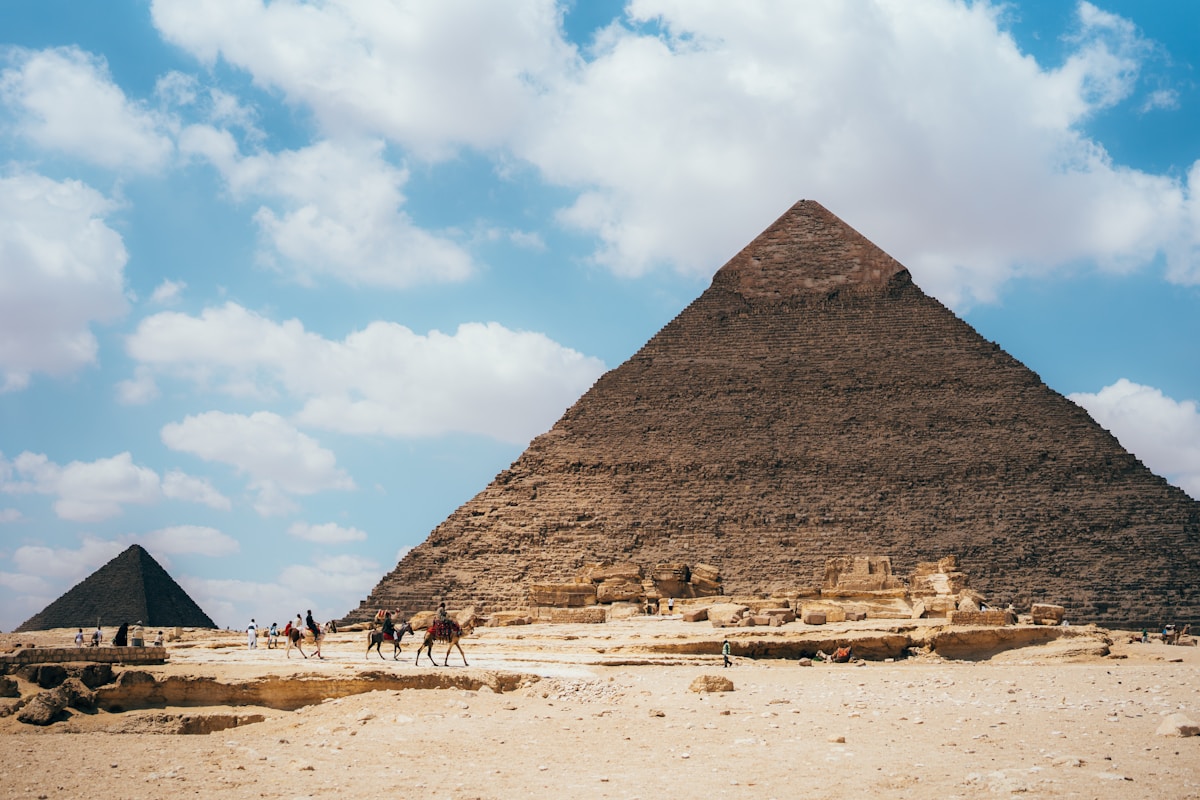
One week is the ideal first trip to Egypt. It gives you three full days in Cairo for the pyramids and museums, two days among the temples and tombs of Luxor, and two days in Aswan where the Nile is at its most scenic. This itinerary moves south through the Nile Valley, following the ancient flow of Egyptian civilisation.
Days 1–3: Cairo
Day 1 - Giza Pyramids and Sphinx
Arrive in Cairo and head straight to the Giza Plateau if your flight lands before noon. The pyramids open at 8:00 AM and general admission costs approximately EGP 540 (USD 11 as of 2026). Entry to the Great Pyramid interior is an additional EGP 1,000 (USD 20) with a daily cap of 300 visitors.
Spend the morning walking the full plateau - the Great Pyramid, the Pyramid of Khafre, the Pyramid of Menkaure, and the Great Sphinx. The panoramic viewpoint on the desert side gives the classic three-pyramid photo.
Lunch: Andrea El Mariouteya near Giza - grilled meats and mezze in a garden setting, approximately EGP 400–600 (USD 8–12) per person.
Dinner: Abou Tarek on Champollion Street for Cairo’s best koshari, approximately EGP 60–80 (USD 1–2) per bowl.
Day 2 - Grand Egyptian Museum and Islamic Cairo
The Grand Egyptian Museum (GEM) opens at 9:00 AM. General admission is approximately EGP 1,000 (USD 20), with a supplementary Tutankhamun ticket at approximately EGP 500 (USD 10). Allow 3–4 hours.
After lunch at Naguib Mahfouz Café (mains EGP 300–500 / USD 6–10), walk through Khan el-Khalili bazaar and south along Al-Muizz Street. Stop at the Qalawun Complex (EGP 100 / USD 2), then the Sultan Hassan Mosque (EGP 200 / USD 4).
Dinner: Zooba in Zamalek for modern Egyptian street food, approximately EGP 250–400 (USD 5–8) per person.
Day 3 - Coptic Cairo and the Citadel
Morning in Coptic Cairo: the Hanging Church, Church of Abu Serga, Ben Ezra Synagogue (all free), and the Coptic Museum (EGP 200 / USD 4, 9:00 AM – 4:00 PM).
Afternoon at the Citadel of Saladin (EGP 450 / USD 9, open until 5:00 PM). The Mosque of Muhammad Ali inside offers panoramic views across Cairo.
End the day at Al-Azhar Park (EGP 120 / USD 2.50) for sunset, then dinner at Sequoia on Zamalek’s northern tip (EGP 800–1,200 / USD 16–24 per person).
Cairo Hotels
- Budget: Cairo Inn (Downtown) - from approximately EGP 1,000 (USD 20) per night
- Mid-range: Steigenberger Hotel El Tahrir - from approximately EGP 3,500 (USD 70) per night
- Upscale: Four Seasons at Nile Plaza - from approximately EGP 15,000 (USD 300) per night
Search hotels in Egypt on Booking.com
For guided Pyramids, GEM, and Islamic Cairo day tours, browse Cairo tours and activities.
Getting to Luxor
Fly from Cairo International to Luxor International. Flights with EgyptAir or Air Cairo take approximately 1 hour and cost EGP 2,500–5,000 (USD 50–100) one way as of 2026. Compare and book Egypt flights at least 2 weeks in advance for the best fares.
The alternative is the Watania overnight sleeper train departing Cairo around 8:00 PM and arriving in Luxor around 5:30 AM. Tickets cost approximately USD 100–120 per person in a private two-berth cabin, including dinner and breakfast.
Days 4–5: Luxor
Day 4 - West Bank: Valley of the Kings, Hatshepsut, Colossi
Cross the Nile to the West Bank early in the morning. Hire a private taxi for the day from your hotel (approximately EGP 800–1,200 / USD 16–24 for 5–6 hours) or join a small group tour (approximately EGP 1,500–2,500 / USD 30–50 per person).
Valley of the Kings - General admission covers 3 tombs and costs approximately EGP 600 (USD 12 as of 2026). Supplementary tickets for the tombs of Tutankhamun (EGP 600 / USD 12), Seti I (EGP 1,400 / USD 28) and Ramesses VI (EGP 200 / USD 4) are sold separately. Open 6:00 AM – 5:00 PM (4:00 PM in winter).
Temple of Hatshepsut (Deir el-Bahari) - EGP 360 (USD 7), a striking colonnaded temple carved into the cliff face.
Colossi of Memnon - free to view, two 18-metre seated statues marking the entrance to Amenhotep III’s vanished mortuary temple.
Lunch: Marsam Hotel Restaurant on the West Bank - simple, honest food with garden seating, approximately EGP 200–350 (USD 4–7) per person.
Day 5 - East Bank: Karnak and Luxor Temples
Karnak Temple Complex - the largest religious complex ever built. General admission is approximately EGP 450 (USD 9 as of 2026). Arrive at opening time (6:00 AM) to walk the Great Hypostyle Hall with its 134 massive columns in relative peace. Allow 2–3 hours.
Walk the 2.7-kilometre Avenue of Sphinxes connecting Karnak to Luxor Temple (EGP 360 / USD 7). The avenue was fully restored and reopened in 2021. Luxor Temple is particularly impressive at dusk when the columns are floodlit.
Dinner: Sofra Restaurant on Mohamed Farid Street - traditional Upper Egyptian dishes served on a rooftop with temple views. Mains approximately EGP 250–450 (USD 5–9).
Luxor Hotels
- Budget: Bob Marley Peace Hotel (West Bank) - from approximately EGP 600 (USD 12) per night
- Mid-range: Steigenberger Nile Palace - from approximately EGP 4,000 (USD 80) per night with Nile views
- Upscale: Sofitel Winter Palace - from approximately EGP 12,000 (USD 240) per night, a historic hotel dating to 1886
For guided Valley of the Kings, Karnak, and West Bank tours, browse Luxor tours and activities.
Getting to Aswan
The train from Luxor to Aswan takes approximately 3 hours and costs EGP 100–250 (USD 2–5) for first class. Trains depart several times daily. A private car with driver costs approximately EGP 2,000–3,000 (USD 40–60) for the 210-kilometre journey and allows a stop at Edfu Temple en route (EGP 360 / USD 7).
Days 6–7: Aswan
Day 6 - Philae Temple, High Dam and Nubian Village
Morning at Philae Temple on Agilkia Island - one of Egypt’s most beautiful temples, rescued from the rising waters of Lake Nasser. A motorboat from the ticket office costs approximately EGP 150–250 (USD 3–5) return for a group. Admission is approximately EGP 450 (USD 9 as of 2026). Open 7:00 AM – 5:00 PM.
Drive to the Aswan High Dam (EGP 100 / USD 2) - the engineering project that transformed modern Egypt. The visit takes 30 minutes.
Afternoon: take a motorboat across the Nile to a Nubian village (approximately EGP 500–800 / USD 10–16 including boat and guide). Walk through the colourfully painted houses, have tea with a local family, and learn about Nubian culture. This is consistently rated as one of the best experiences in Egypt.
Dinner: The Terrace at Old Cataract Hotel - dine where Agatha Christie wrote parts of Death on the Nile. Mains approximately EGP 600–1,000 (USD 12–20). Dress code is smart casual. Reserve in advance.
Day 7 - Abu Simbel Day Trip
The twin temples of Abu Simbel are 280 kilometres south of Aswan, near the Sudanese border. Most visitors take an organised day trip departing at 4:00 AM and returning by early afternoon. Options:
- Minibus convoy: approximately EGP 1,200–1,800 (USD 24–36) per person, round trip
- Private car: approximately EGP 4,000–5,000 (USD 80–100) round trip for the vehicle
- Flight: EgyptAir operates a 45-minute flight for approximately EGP 5,000–8,000 (USD 100–160) return
Abu Simbel admission costs approximately EGP 550 (USD 11 as of 2026). The four colossal statues of Ramesses II at the Great Temple are among the most recognisable monuments in Egypt.
Return to Aswan for a late lunch and a felucca ride around Elephantine Island (approximately EGP 300–500 / USD 6–10 for 1–2 hours). Watch the sunset from the water before heading to the airport for your evening flight back to Cairo (approximately EGP 3,000–5,500 / USD 60–110).
Aswan Hotels
- Budget: Keylany Hotel - from approximately EGP 800 (USD 16) per night with rooftop Nile views
- Mid-range: Basma Hotel - from approximately EGP 3,000 (USD 60) per night
- Upscale: Sofitel Legend Old Cataract - from approximately EGP 15,000 (USD 300) per night, one of the world’s great heritage hotels
For guided Philae Temple, Nubian village, and Abu Simbel excursions, browse Aswan tours and activities.
Budget Summary
| Category | Budget | Mid-Range | Upscale |
|---|---|---|---|
| Accommodation (6 nights) | EGP 5,400 (USD 108) | EGP 22,000 (USD 440) | EGP 72,000 (USD 1,440) |
| Food (7 days) | EGP 2,800 (USD 56) | EGP 7,000 (USD 140) | EGP 14,000 (USD 280) |
| Sightseeing | EGP 4,500 (USD 90) | EGP 6,000 (USD 120) | EGP 8,000 (USD 160) |
| Domestic flights | EGP 5,500 (USD 110) | EGP 7,000 (USD 140) | EGP 12,000 (USD 240) |
| Local transport | EGP 1,500 (USD 30) | EGP 3,000 (USD 60) | EGP 6,000 (USD 120) |
| Total | EGP 19,700 (USD 394) | EGP 45,000 (USD 900) | EGP 112,000 (USD 2,240) |
All prices approximate as of 2026.
Practical Tips
- Connectivity: An eSIM for Egypt from Airalo is the easiest way to get data the moment you land - no SIM swap required at the airport. Travel insurance is strongly recommended given the distances covered on this itinerary.
- Domestic flights: Book EgyptAir or Air Cairo flights 2–4 weeks ahead. Prices spike during peak season (October–March).
- Guides: A licensed guide costs approximately EGP 1,500–2,500 (USD 30–50) per half day. At complex sites like Karnak and Valley of the Kings, a guide transforms the experience.
- Hydration: Carry at least 2 litres of water per person when visiting outdoor sites, especially in Upper Egypt where temperatures regularly exceed 35°C.
- Photography: Camera fees have been abolished at most sites, but tripods and drones remain prohibited without special permits.
More Egypt Itineraries
- 5 Days in Egypt
- 10 Days in Egypt
- 2 Weeks in Egypt
- 3 Weeks in Egypt
- Egypt on a Budget
- Egypt History Itinerary
- Red Sea and Sinai Itinerary
- Luxor Itinerary
- Aswan Itinerary
- 3 Days in Cairo
- Egypt Nile Cruise Itinerary
- Browse Egypt tours and guided experiences - compare Pyramids tours, Nile cruises, and Luxor guided days
- Last-minute Egypt tours - already travelling? See what still has availability for tomorrow
Book Your Trip
- Flights - Find the best fares to Egypt
- Travel Insurance - Get covered before you go
- eSIM - Stay connected from landing
- Airport Transfers - Pre-book your transfer from Cairo or Hurghada
- Car Rental - Compare prices across providers
- Tours & Activities - Browse Egypt tours on GetYourGuide