Egypt Photography Guide: Best Spots, Light, and Access Tips by Region
Contents
- Understanding Egyptian Light
- Cairo and Giza
- The Pyramids of Giza
- Islamic Cairo (Khan el-Khalili and Surroundings)
- Cairo from Above
- Luxor
- Karnak Temple
- Luxor Temple
- West Bank: Valley of the Kings
- The Corniche at Blue Hour
- Aswan and Upper Egypt
- Abu Simbel
- Nubian Villages (Aswan)
- The Red Sea Coast
- Underwater Photography
- Surface Landscape
- The Sahara and Western Desert
- White Desert
- Siwa Oasis
- Permissions, Ethics, and Practical Notes
Egypt is one of the most photographed countries on earth — and also one where the gap between postcard images and what a visiting photographer actually captures can be enormous. The light is extraordinary, the subjects are world-class, and the challenges (crowds, access restrictions, persistent touts) are real. This guide is about closing that gap.
Understanding Egyptian Light
Egypt’s desert latitude (approximately 22°N to 31°N) means intense midday sun that flattens colour and adds harsh shadows. The magic hours here are compressed but exceptional:
- Sunrise: Clear, soft, golden. Dust in the air from overnight winds often creates a warm atmospheric haze. Best for the Pyramids, Sahara landscapes, and Nile mist.
- The hour before sunset: Gold turns quickly to deep orange and crimson. Temple reliefs come alive with angled light picking out carvings that disappear at noon.
- Blue hour post-sunset: Short but vivid, particularly in Luxor where temples are lit for evening visits.
- Midday: High contrast, useful for black-and-white work and architectural detail shots, but difficult for colour landscapes.
Plan your days around two shooting windows: 6–9am and 3–7pm. The middle of the day is for indoors, shade, eating, or moving between locations.
Cairo and Giza
The Pyramids of Giza
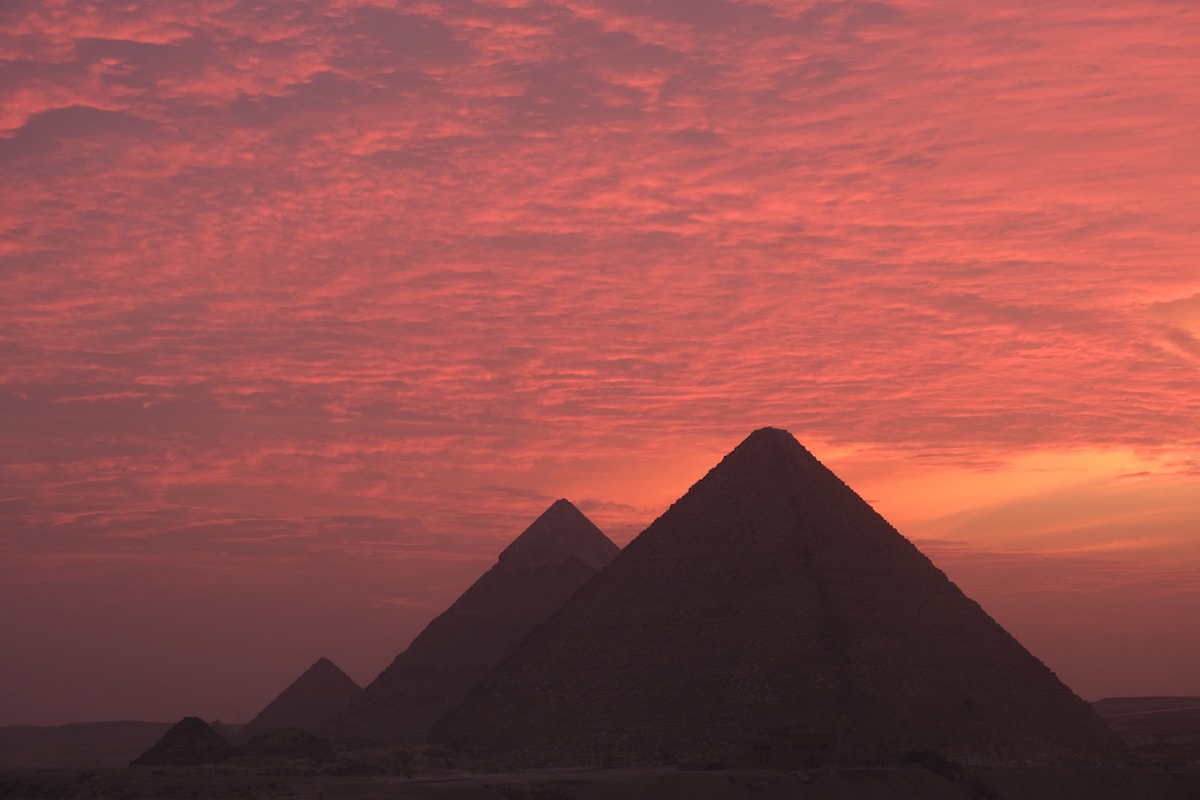
The most photographed structures on earth remain deeply challenging to photograph well. The problem isn’t the Pyramids themselves — it’s context. On the east side (main entrance), the vast plateau faces the city of Giza, which creeps right to the edge of the archaeological zone. The backdrop for a “clean” pyramid shot requires careful framing.
Best spots:
-
Panoramic Platform (Road of the Dead, west side): The desert-facing viewpoint on the plateau’s western edge gives all three pyramids lined up with empty sand behind them. This is where the classic three-pyramid shot is taken. Accessible via a 4WD tour or motorcycle around the plateau perimeter. Tell your driver “the panoramic view” or show the Arabic text.
-
Sound and Light Show viewing stand: On the east side, elevated; gives a direct line on the Sphinx with the Khafre Pyramid behind. Come early to set up.
-
From the Sphinx enclosure: Low angle, looking up at the Sphinx with Khafre’s pyramid rising directly behind. The site opens at 8am; get there as early as possible before tour groups arrive.
-
Rooftop access near the KFC on the plateau edge: Several buildings on the boundary road have rooftops rented informally for sunset views. Baksheesh expected; quality of access varies by day.
Sunrise: Gates open at 7am (winter) or 6am (summer). Get there at opening for the first 45 minutes of crowd-free shooting. A local fixer who can get you onto the plateau at dawn before the official opening time is worth finding through your hotel if dawn photography is important to you.
Camera settings starting point: At sunrise, start around ISO 400, f/8, 1/125s and adjust. Bracketing is wise — the sky and sand are often significantly different in exposure.
Islamic Cairo (Khan el-Khalili and Surroundings)
This is Egypt’s best street photography zone. Al-Muizz Street, the oldest commercial street in Cairo, is a UNESCO-recognised medieval streetscape — minarets, stone facades, stalls of copper and spice, schoolchildren in uniforms, men carrying impossible loads on bicycles.
Best areas:
-
Al-Muizz Street: Photographed at either end to get the street narrowing into the distance with minarets. Best at golden hour (5–6pm) when the light is warm and the fabric stalls glow. Closed to cars from 7pm; become a pedestrian zone that’s easier to shoot.
-
Mosque of Ibn Tulun: One of Cairo’s oldest mosques (9th century) and one of the most photogenic — a vast courtyard with a spiral minaret unlike anything else in the city. Photography inside is typically permitted. Entry approximately EGP 100 for foreigners.
-
Tentmakers’ Bazaar (Khan el-Khayamiyya): A covered arcade south of Bab Zuweila where craftsmen make and sell appliquéd textiles. Excellent for close-up craft photography and portraits — the men here are generally used to photographers and happy to be shot (ask first).
Cairo from Above
For a skyline perspective: the Cairo Tower on Gezira Island gives panoramic views (entry approximately EGP 200 for foreigners; open until 1am); the viewing terrace of the Four Seasons Nile Plaza (open to non-guests for drinks) has unobstructed Nile views. The ridge road in Moqattam Hills gives Cairo stretching to the horizon with the Pyramids visible on clear days.
Luxor
Luxor is Egypt’s densest concentration of ancient monuments and arguably the most rewarding place in the country for a photographer. The temples are vast, the light in Upper Egypt (further south) is slightly softer than Cairo, and the river provides reflections that don’t exist further north.
Karnak Temple
The largest religious complex ever built. The Hypostyle Hall — a forest of 134 columns, each 23 metres tall — is one of the most striking interior spaces on earth. The columns are most atmospheric at:
- Low morning light (7–9am): Shafts of light cut between columns. Shoot looking east with the sun behind you initially, then turn to catch it filtering through.
- Photography permit: Usually included in standard entry (approximately EGP 200 for foreigners as of 2026). Verify at the gate.
- Tripod: Permitted in open areas; check at tombs and enclosed spaces. The dim light in the Hypostyle Hall demands either a tripod or a camera with strong high-ISO performance (Sony A7 series, Nikon Z, or equivalent).
Luxor Temple
Unlike Karnak, Luxor Temple is open until 10pm and fully illuminated at night. Evening photography (7–10pm) gives you warm orange light on the stone, near-empty pathways, and the famous illuminated avenue of sphinxes. The temple’s scale is more intimate than Karnak, making composition easier.
West Bank: Valley of the Kings
Photography inside the tombs is either prohibited or requires a paid photography ticket. Check at the gate — policies change and are site-specific. The exterior landscape around the Valley is spectacular: limestone cliffs that glow amber at sunrise, the desolate grandeur of the mountain rising behind Deir el-Bahri. The hilltop path above Deir el-Bahri gives a view looking down into the Hatshepsut Temple bowl that almost no tourists reach — ask a local guide to show you the path.
Sunrise balloon flight over Luxor: Hot air balloon flights (approximately USD 60–100 per person from Luxor operators; book directly or via Viator-style platforms) take off at dawn and provide aerial views of the West Bank temples, the Nile, and the East Bank city. A wide-angle zoom is the most useful lens. Sunrise here (roughly 5:30–6am in summer, later in winter) gives extraordinary colours over the Nile.
The Corniche at Blue Hour
The riverfront promenade in Luxor at dusk, with the Nile calm and the East Bank lit behind — and Luxor Temple visible at the south end — is a reliable, uncrowded shooting location. Small felucca boats with lanterns are rentable from approximately EGP 150–200 for an evening hour on the river.
Aswan and Upper Egypt
Abu Simbel
Abu Simbel’s four colossal statues of Ramesses II (each 20 metres high) are most dramatically photographed in the morning. The temple faces east, so direct sunlight hits the facades from approximately 6am in summer and 7am in winter. The interior has a famous alignment phenomenon on 22 February and 22 October each year, when sunlight penetrates 65 metres into the temple to illuminate the statues of the gods — photographers book accommodation in Abu Simbel to be inside at dawn on those dates. See the Abu Simbel site authority for exact sunrise times.
Getting there: Abu Simbel is a 3-hour drive from Aswan on a desert road, or a 45-minute flight. Most photographers who are serious about Abu Simbel take the early morning convoy (departs Aswan around 3–4am) to arrive at sunrise, spend 2–3 hours shooting, and return by midday.
Nubian Villages (Aswan)
The painted houses of Nubian villages across the Nile from Aswan — in shades of cobalt blue, ochre, and terracotta — are remarkable portrait and documentary subjects. Felucca rental (approximately EGP 80–120 per hour from Aswan corniche) takes you across. The communities welcome visitors with tea; asking permission before pointing a camera at individuals is expected and appreciated.
The Red Sea Coast
Underwater Photography
The Red Sea may be Egypt’s best photography environment. Visibility of 20–30 metres, colourful coral starting at 1 metre depth, and extraordinary fish density make even entry-level underwater cameras perform well. Key considerations:
- A GoPro (HERO11/12) with red filter gives decent results for video and stills down to 10 metres.
- For serious still photography: a mirrorless in an underwater housing (Nauticam, Ikelite, or Sea and Sea) paired with a wide-angle dome port gives the best results.
- Macro photography in the Red Sea is underrated: nudibranch species, pygmy seahorses, frogfish, and ghostpipefish are resident at many sites.
- Best sites for photography: Ras Mohammed (wall diving and fish density), the Blue Hole at Dahab (dramatic architecture with sunbeams), and the SS Thistlegorm wreck (military hardware and marine life).
Surface Landscape
The desert-meets-sea landscapes of the Sinai Peninsula — red and orange mountains dropping directly into the deep blue Red Sea — are photographed most effectively from the water, looking back at shore. Boat tours from Dahab and Sharm include these perspectives without extra effort.
The Sahara and Western Desert
White Desert
The chalk formations of the White Desert, reached via Bahariya Oasis (approximately 4 hours from Cairo), are at their most surreal at night. A full moon illuminates the white rocks against a blue-black sky in a way that requires no artificial light. Astrophotography here is exceptional: light pollution is virtually zero, and the Milky Way is visible with the naked eye. Bring a wide-angle lens (14–24mm) and a tripod; ISO 3200–6400, aperture f/2.8, 20–25 second exposures as starting point.
Dawn in the White Desert gives the rocks a pink-orange glow that lasts about 30 minutes before becoming harsh. Most camping tours depart Cairo in the afternoon, overnight in the desert, and photograph sunrise before driving back.
Siwa Oasis
Siwa’s mud-brick ruins (Shali Fortress), palm groves, salt lakes, and surrounding dunes provide a photographic environment completely different from Egypt’s Nile Valley. The fortress is illuminated at night. The dunes at Great Sand Sea, reachable by 4WD from Siwa, give classic Saharan landscape with the highest dunes in Egypt. Morning and late afternoon are the only workable light windows.
Permissions, Ethics, and Practical Notes
- Museum photography: The Grand Egyptian Museum charges a separate photography fee (verify at entry — approximately EGP 100–300). The Egyptian Museum in central Cairo has an interior photography ticket. Check requirements at each museum.
- People photography: Street photography is legal in public spaces. In practice, ask first — people often want to see the result. In rural and traditional areas, photographing women without permission is considered deeply disrespectful.
- Restricted areas: Do not photograph military personnel, police checkpoints, border zones, or security installations. Confiscation of memory cards and equipment has occurred.
- Memory cards and batteries: Power cuts occasionally affect hotels; carry charged spares. In the extreme heat of summer, lithium batteries drain faster than usual.
- Dust and heat: Desert wind carries fine sand that infiltrates everything. A camera bag with a good closure, a lens cloth, and a blower brush are essential kit. Lens changes in wind or sandstorm conditions invite disaster — change inside a vehicle or bag.
Book an experience
Popular experiences
While you research, browse the most-booked experiences — all with instant confirmation.
Frequently Asked Questions
- Can you take a camera into Egyptian temples and tombs?
- Yes, but rules vary by site. Most temples allow photography freely. Some tombs in the Valley of the Kings prohibit photography inside to protect paintings — pay for a photography ticket at the gate if offered, or check with the site authority on the day. The Egyptian Museum in Cairo prohibits photography without a ticket (approximately EGP 50–100 extra).
- Is it legal to take photographs of people in Egypt?
- Street photography is generally tolerated in public spaces, but always ask permission when photographing individuals, especially women. Photographing military installations, bridges, airports, or government buildings is prohibited and can result in confiscation of equipment. When in doubt, ask.
- What is the best time of day to photograph the Pyramids?
- Sunrise and sunset give the most dramatic light. Sunrise (approximately 6–7am depending on season) means very few tourists and golden light on the stone. Sunset gives orange tones and silhouettes but slightly more crowds. The Sound and Light Show at Giza (most evenings) gives a different perspective after dark.
- What camera gear should I bring to Egypt?
- A wide-angle lens (16–24mm on full-frame) is essential for interiors and vast temple complexes. A telephoto (70–200mm) is useful for detail shots and compressing the desert landscape. A tripod is useful in tombs but may require a photography permit. A UV filter helps cut desert haze. Bring spare batteries and memory cards — reliable sources in remote areas are limited.
- Are there drone restrictions in Egypt?
- Yes, drone regulations in Egypt are strict. Commercial and even personal drone use requires a permit from the Egyptian Civil Aviation Authority and in many cases is effectively unavailable to visitors without advance official approval. Flying drones over archaeological sites and military areas is prohibited. Do not bring a drone expecting to use it freely — many are confiscated at entry.