Egypt and Jordan are neighbours separated by the Gulf of Aqaba, and their proximity makes them a natural pairing for a single Middle East trip. Both have ancient ruins that rank among the world’s finest, both border the Red Sea, and both offer a depth of human history that few regions can match. But they’re not interchangeable - and understanding how they differ will help you decide whether to pick one or find a way to do both.
The Fundamental Contrast
Egypt is older, bigger, and more intense. The pharaonic monuments at Giza, Luxor, and Abu Simbel represent one of humanity’s earliest and greatest civilisations, and visiting them requires absorbing vast scales - temples built for gods, tombs cut into mountains, colonnades as long as city blocks. Egypt also has the Nile, the Red Sea coast, and Cairo’s chaotic, thrilling urban energy.
Jordan is smaller and more easily navigated, but no less remarkable. Petra - the rose-red city carved by the Nabataeans into sandstone cliffs - is one of the most dramatic archaeological sites anywhere, and Wadi Rum’s desert landscapes are otherworldly. The country also holds the Roman city of Jerash, the Crusader castle at Karak, and the unique sensory experience of floating in the Dead Sea.
Pyramids vs Petra: The Headline Comparison
Both sites deserve their reputation. The Pyramids of Giza are larger and older (built around 2550–2490 BCE), and the combination of scale, age, and mystery - reinforced by the presence of the Sphinx - is unlike anything else on earth. Entry to the Giza plateau costs approximately EGP 540 per person (as of 2026), with separate tickets for individual pyramids.
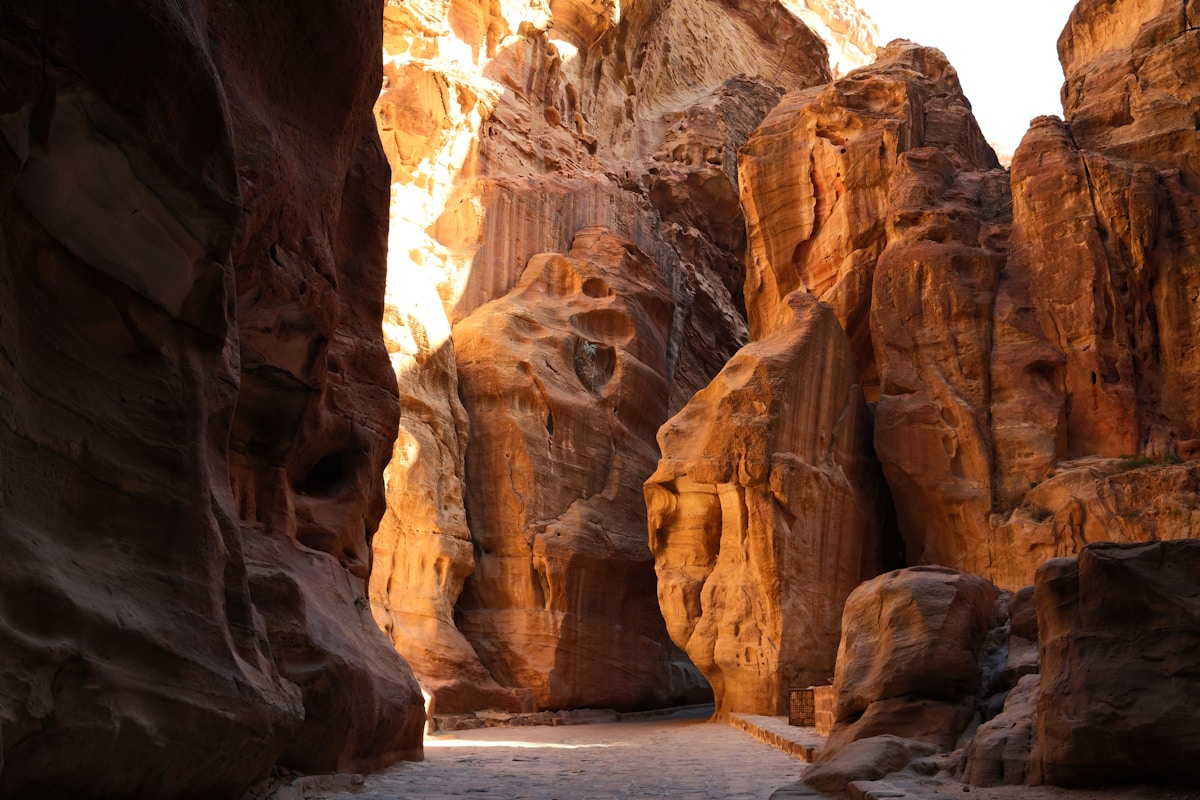
Petra’s Treasury (Al-Khazneh) is the more cinematic single image, and the approach through the Siq - a 1.2 km narrow canyon between 80-metre sandstone walls - builds a theatrical tension that delivers a genuine reveal. But Petra is bigger than its cover photo: the full site contains hundreds of carved tombs, a Byzantine church, a Roman colonnaded street, and a High Place of Sacrifice, spread across a 264 sq km protected area. The Jordan Pass (approximately JOD 70–75 including Petra for a 1-night visit, or JOD 80 for 2+ nights) is the most cost-effective way to buy entry as of 2026.
Our take: The Pyramids are older and more awe-inspiring for their sheer scale. Petra is more dramatic and has greater walkable variety. They don’t compete - they complement.
History: Range and Depth
Egypt’s historical timeline spans 5,000 years of continuous civilisation. The sites cluster in Cairo (Giza, Saqqara, Egyptian Museum), Upper Egypt (Luxor, Karnak, Valley of the Kings, Abu Simbel), and Alexandria (Greco-Roman legacy). A serious historical itinerary needs at least 8–10 days to cover the major sites adequately. The Egyptian Museum in Cairo alone requires half a day minimum and houses over 100,000 artefacts including Tutankhamun’s gold death mask.
Jordan’s historical range is smaller in timeline but concentrated in impact. Petra dates from the 4th century BCE to the 7th century CE. Jerash (a 2-hour drive north of Amman) is among the best-preserved Roman provincial cities in the world, with an intact hippodrome, colonnaded streets, and two theatres - entry approximately JOD 10. Madaba holds the oldest surviving map of the Holy Land in mosaic form. The castles of the desert highway (Qasr Amra, Karak) fill in the Islamic and Crusader eras. Jordan can be covered in 5–7 days without major gaps.
For historical density: Egypt. For efficient historical variety: Jordan.
Red Sea vs Dead Sea
These are two of the world’s most distinctive bodies of water, but they offer almost opposite experiences.
The Red Sea (accessible from Hurghada, Sharm el-Sheikh, Dahab, and Aqaba on the Jordanian side) is warm, clear, and biologically rich. Visibility can reach 30 metres on calm days. The coral reefs around Ras Mohammed National Park, the Thistlegorm wreck off Sharm, and the Blue Hole at Dahab are world-famous dive sites. Water temperatures stay comfortable year-round (24–28°C). Snorkelling off the beach is possible at many Red Sea spots without a boat.
The Dead Sea lies 430 metres below sea level - the lowest point on earth’s surface - and has a salt concentration of around 34%, making it ten times saltier than the ocean. You cannot sink. Floating on the surface is a genuinely strange and memorable sensation. The mineral-rich black mud is used for skin treatments. The experience is brief by nature (you can’t actually swim or submerge your face), but it’s genuinely unique. The Dead Sea is accessible from Amman in under an hour; day-trip rates from Amman hotels start from approximately JOD 25–40 including transport.
Winner for extended water activities: Egypt’s Red Sea, by a significant margin. Winner for unique one-off experience: Dead Sea.
Wadi Rum: Jordan’s Edge
Egypt has the White Desert and the Western Sahara, but Jordan’s Wadi Rum is in a different category for dramatic desert landscape. The sandstone formations - some 300 metres high - turn vivid orange and red at sunrise and sunset. Overnight camps in Wadi Rum range from basic Bedouin tents (approximately JOD 30–50 per person including dinner and breakfast) to luxury “bubble tent” camps with transparent domed ceilings (JOD 150–250+). Jeep tours of the desert cost approximately JOD 30–50 for a half day. Lawrence of Arabia was filmed here; The Martian used it to double as Mars.
Egypt’s White Desert (accessible from Bahariya Oasis via Cairo) has its own surreal chalk formations - white rock “mushrooms” rising from the orange sand - but it requires more logistical effort to reach and lacks Wadi Rum’s dramatic scale.
Cost
| Category | Egypt (approx.) | Jordan (approx.) |
|---|---|---|
| Budget daily spend | USD 40–60 | USD 65–90 |
| Mid-range daily spend | USD 80–130 | USD 110–160 |
| Key attraction entry | USD 5–15 per site | USD 15–50 per site |
| Local meal | USD 3–6 | USD 8–15 |
| Domestic transport | Very affordable | Moderate |
Jordan’s cost is elevated partly by its own living standards and partly by deliberate pricing at major sites. The Jordan Pass (approximately JOD 70–80 as of 2026) covers entry to 40+ sites including Petra and is the standard way to manage costs if you’re visiting for 3+ nights. Egypt remains one of the most affordable destinations in the region, particularly following the Egyptian pound’s depreciation since 2022.
Combining Egypt and Jordan
This is genuinely easy to do:
Flying: Cairo (CAI) to Amman (AMM) is approximately 2 hours with direct flights on EgyptAir, Royal Jordanian, and budget carriers. Prices range from USD 80–200 depending on season.
Overland via Aqaba: Some travellers take the bus from Cairo to Nuweiba, ferry across the Gulf of Aqaba to Aqaba in Jordan, then continue north to Petra and Amman. The ferry takes 3–4 hours; this route is scenic but logistically complex and requires a full day of travel.
Typical 12–14 day combined itinerary:
- Days 1–2: Cairo (Pyramids, Egyptian Museum, Coptic Cairo)
- Days 3–4: Luxor (Karnak, Valley of the Kings, Luxor Temple)
- Day 5: Aswan or fly to Amman
- Day 6: Amman orientation + Jerash day trip
- Days 7–8: Petra (2 days to do justice to the full site)
- Day 9: Wadi Rum overnight camp
- Day 10: Aqaba for Red Sea snorkelling
- Day 11: Dead Sea
- Day 12: Fly home from Amman
Which Should You Choose?
Choose Egypt if: you want the most ancient and monumental history on the planet, world-class snorkelling and diving, Nile cruise experiences, and outstanding value for money. Egypt rewards a longer visit and repays repeat trips.
Choose Jordan if: you want a more compact experience with Petra at its centre, magnificent desert landscape in Wadi Rum, easy access to the Dead Sea, and a well-organised tourist infrastructure that is slightly easier to navigate solo.
Visit both if: you have 12 or more days and a moderate budget. The contrast between the two countries - different eras, different landscapes, different cultures - makes each richer in retrospect. Few combinations of two countries deliver as much ancient history per trip as Egypt and Jordan together.
Plan Your Egypt Trip
- 2 weeks in Egypt itinerary - the full Egypt tour that fits naturally before or after Jordan
- Egypt travel budget - a detailed cost breakdown to compare realistically with Jordan pricing
- Egypt visa guide - visa requirements, the Sinai stamp, and e-visa process for Egypt
- Browse Egypt tours for first-time visitors - compare Pyramids, Nile cruise, and Luxor packages