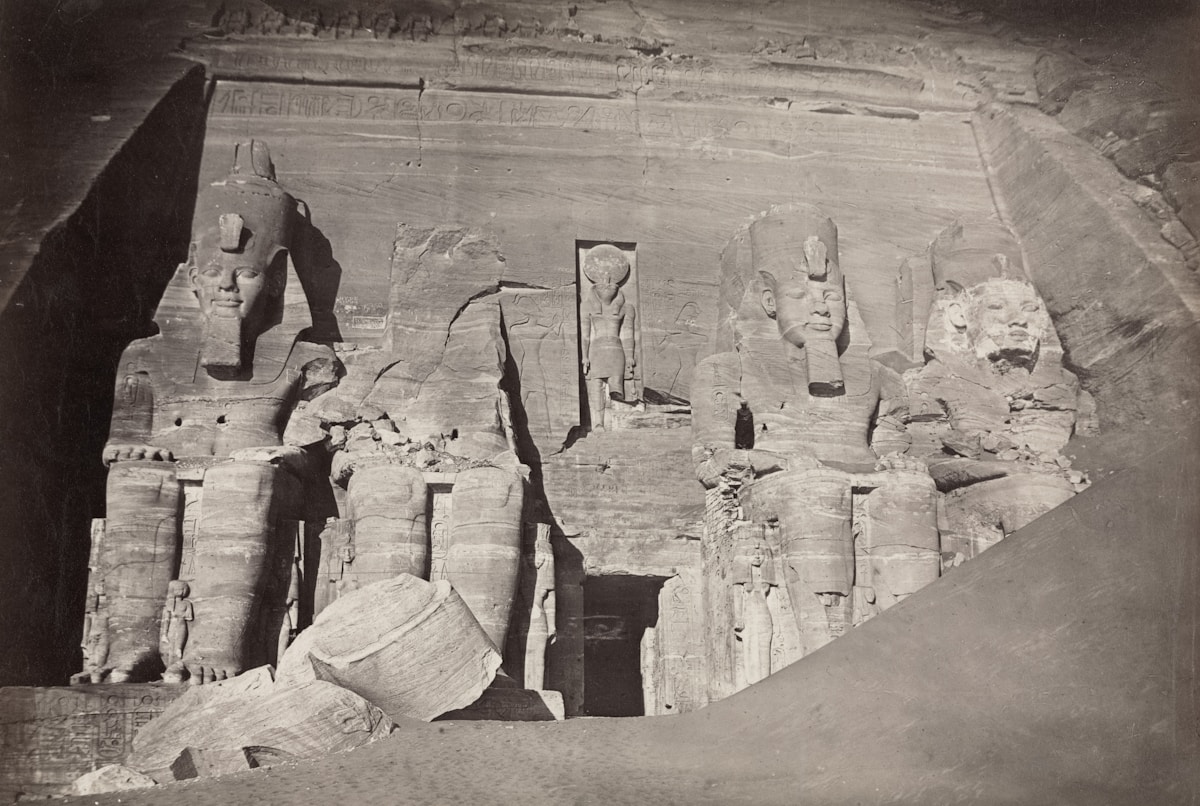
Abu Simbel is built around a single extraordinary thing: two rock-cut temples constructed by Ramesses II in the 13th century BC, relocated in their entirety between 1964 and 1968 to save them from the rising waters of Lake Nasser. The relocation - one of the largest archaeological engineering operations ever attempted - is itself part of the site’s significance. The temples and the story of how they came to stand where they do today are inseparable.
The town of Abu Simbel is small and has no meaningful visitor attractions beyond the temples. This is not a destination for a multi-day exploration - it’s a destination for the temples.
Great Temple of Ramesses II
The Great Temple is announced by four colossal seated statues of Ramesses II, each 20 metres high, carved directly from the cliff face of the artificial mountain that now houses the reconstructed complex. One of the original statues was damaged in an ancient earthquake - the upper section fell and was not restored during the UNESCO relocation, a deliberate curatorial decision.
Inside, the hypostyle hall is supported by eight Osiris-form pillars bearing the face of Ramesses II. The walls carry detailed painted reliefs of military campaigns, most notably the Battle of Kadesh - the largest recorded land battle of the ancient world, fought against the Hittites around 1274 BC. The inner sanctuary (the Holy of Holies) contains four seated deities: Ptah, Amun-Ra, Ramesses II, and Ra-Horakhty. On two days per year - approximately 22 February and 22 October - the rising sun penetrates the full length of the temple to illuminate three of the four statues (Ptah, as a deity of darkness, remains in shadow). These dates are widely believed to correspond to Ramesses II’s birthday and coronation, though the precise alignment was established by the UNESCO engineers during the relocation. Allow 60–90 minutes for the interior.
Small Temple (Temple of Nefertari)
The Small Temple, 100 metres from the Great Temple, was dedicated to Queen Nefertari, Ramesses II’s principal wife, and to the goddess Hathor. Its facade carries six colossal statues - four depicting Ramesses II and two depicting Nefertari. The fact that the queen appears at equal scale to the pharaoh is unusual in ancient Egyptian temple architecture; standard practice placed the queen at ankle height. The interior is decorated with painted reliefs showing Nefertari making offerings to Hathor. The colour retention in the painted scenes is better than in many comparably ancient sites. Allow 30–45 minutes.
The UNESCO Relocation
The artificial mountain behind and above both temples was constructed specifically to house the relocated stone masses. During the original cliff, the temples were carved directly into the rock face. The UNESCO project (1964–1968) cut the temples into approximately 1,050 pieces, each weighing up to 30 tonnes, and reassembled them inside the engineered hill 65 metres back from the original position and 30 metres higher. A reinforced concrete dome supports the hillside above. Some guided tours or groups with special access can view the interior of the dome structure. The relocation was funded by international contributions from 50 countries - it remains the model for UNESCO emergency heritage rescue operations.
Sound and Light Show
An evening Sound and Light Show is performed at Abu Simbel, with narration telling the story of Ramesses II and the temples’ relocation. Scheduling and availability vary - check current performance times locally as they can change seasonally. Attending the show requires either staying overnight in Abu Simbel or arranging evening transport from Aswan, which adds significant complexity. It is a reasonable experience rather than an essential one; the temples themselves in daylight are the primary draw.
Search hotels in Abu Simbel on Booking.com
Lake Nasser
The body of water immediately in front of Abu Simbel is Lake Nasser - the reservoir created by the Aswan High Dam, one of the largest artificial lakes in the world. Boat trips on Lake Nasser from Abu Simbel are possible but not standard (most are arranged from Aswan). The 2–4 day Lake Nasser cruise route between Aswan and Abu Simbel stops at several rescued Nubian temples along the shore. For those arriving by the day trip route, the view of the lake from the temple area is part of the site’s atmosphere - the scale of the water and the barren landscape give a clear sense of what the UNESCO engineers were racing against.
See also our Abu Simbel guide, temple history article, and Aswan guide. For guided Abu Simbel day trips from Aswan with transport included, browse Abu Simbel tours.