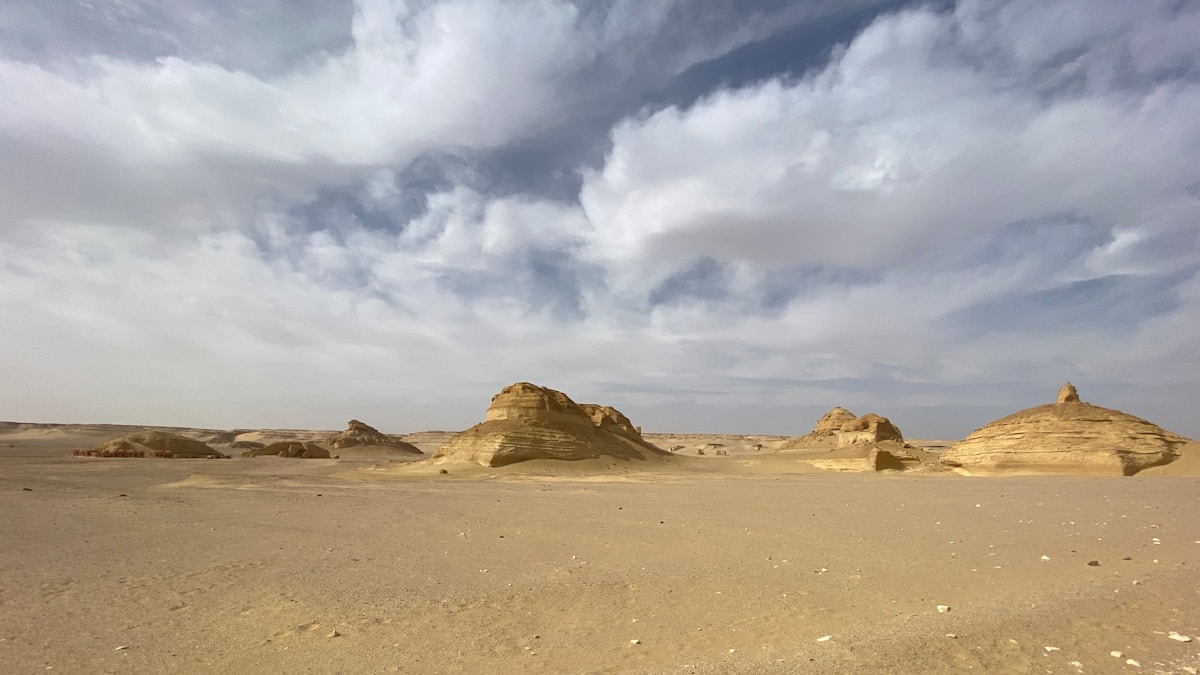
Wadi Hitan is the one site in Egypt that has nothing to do with pharaohs. Roughly 150km southwest of Cairo, in a remote corner of the Fayoum depression, this dried valley holds the most complete fossil record of early whale evolution on Earth - over 1,000 whale skeletons partially exposed by desert winds, preserved exactly where the animals died in a shallow sea 37 to 40 million years ago. UNESCO listed it as a World Heritage Site in 2005.
Why UNESCO Listed It
The significance of Wadi Hitan lies in what the fossils prove. These are archaeocetes - transitional whales that still had functional hind legs, a body plan caught halfway between land mammal and fully aquatic creature. The most famous species found here, Basilosaurus isis, could reach 18 metres in length but retained small rear limbs it used for grasping during mating, not for walking. Finding hundreds of complete skeletons in a single location, with the evolutionary transition documented across multiple species in the same stratigraphy, is what earned the site its listing. Nowhere else in the world offers this scale of transitional fossil evidence.
The site also contains fossils of early sharks, rays, sea turtles, and sawfish - confirming that this entire desert was once the Tethys Sea, the ancient ocean that separated Africa from Eurasia before the continents closed.
Getting There from Cairo
Distance and road: Wadi Hitan is approximately 150km from Cairo city centre by the most direct route. Take the Desert Road south from the 6th of October junction, continue past Fayoum city turnoffs, and follow signs for Wadi El Rayan Protected Area - the park that contains Wadi Hitan. From the park checkpoint, the fossil valley is a further 30–35km on unpaved desert track.
Self-drive: You need a 4WD vehicle - not optionally, but genuinely. The unpaved track crosses soft sand sections where saloon cars frequently become beached. Renters at Cairo airport can supply 4WDs from around USD 70–90 per day as of 2026. Navigation on the desert track is poor; download offline maps and share a GPS pin with someone before setting out. Allow 3–3.5 hours from Cairo under normal conditions.
Organised tour: The more practical option for most visitors. Day tours from Cairo run approximately EGP 1,800–2,500 per person (as of 2026), including 4WD transport, a guide, and park entry. Overnight tours combining Wadi Hitan with the Wadi El Rayan waterfalls and Magic Lake cost roughly EGP 2,500–3,500.
| Tour | Duration | Price (from) | Group Size | Highlights |
|---|---|---|---|---|
| Fayoum Desert & Wadi Hitan Day Trip from Cairo | Full day | from $65 | Small group | 4WD transport, fossil trail, Fossil Museum, park entry |
| Wadi Hitan & Wadi El Rayan Day Tour | Full day | from $75 | Small group | Valley of the Whales, Magic Lake, Wadi El Rayan waterfalls |
| Private Fayoum Desert Full-Day Experience | Full day | from $120 | Private | Wadi Hitan fossils, Tunis village, Lake Qarun, 4WD |
Browse all Cairo day tours → GetYourGuide
Fayoum-based approach: Staying one night in Tunis village (see Accommodation below) and driving to Wadi Hitan in the morning cuts the desert track to around 45 minutes from the village and is far more manageable than the long Cairo day-trip.
Entry Fees and Opening Hours
The Wadi El Rayan Protected Area checkpoint collects fees before you reach the fossil valley. As of 2026:
- Visitors: approximately EGP 200 per foreign adult
- Vehicle: approximately EGP 50 for a private car
- Cameras/video: a separate permit of around EGP 50 may be requested for professional equipment
The site opens at 8am and closes at 4pm daily. Rangers do not permit entry after 3pm to ensure everyone is back before dark. Confirm current fees directly with the protected area administration or your tour operator before arrival - Egyptian heritage site fees have increased significantly since 2022 and may continue to rise.
The Fossil Museum
The starting point for any visit is the Wadi Hitan Fossil and Climate Change Museum, opened in 2016 and designed with an arched roof that echoes the whale ribcages inside. Entry is included in the park fee.
The museum holds six complete mounted whale skeletons, including a full Basilosaurus isis specimen that stretches across most of the main hall - at around 18 metres it dominates the room. Interpretation panels (in Arabic and English) explain the evolutionary biology, the geology of the Tethys Sea, and how the fossils were excavated. A dedicated climate section shows how the landscape changed from shallow sea to desert over 40 million years.
Allow 30–45 minutes here before tackling the outdoor trail. The air conditioning makes it the obvious midday shelter if you visit in shoulder season.
The Outdoor Fossil Trail
From the museum, a marked 3km walking circuit threads between major fossil exposures. Numbered posts correspond to a paper map distributed at the entrance. The trail surface is packed desert - no pavement, moderate sun exposure. Bring more water than you think you need.
Key stops on the circuit:
Stop 3 - The Hind-Limb Skeleton: The most visited point. A partial Basilosaurus skeleton is displayed in situ behind a low enclosure, with the small but unmistakeable hind limbs still articulated. Interpretive signage explains why these rudimentary legs matter evolutionarily. Good natural light for photography in the morning.
Stop 5 - The Dorudon Cluster: A group of Dorudon atrox skeletons - a smaller, more dolphin-shaped archaeocete species - exposed across a 20-metre section of the valley floor. These are younger than the Basilosaurus specimens and show a more advanced body plan.
Stop 7 - The Wind-Sculpted Ridge: Not a fossil point but a landscape viewpoint from a low limestone ridge looking north across the valley. The erosion patterns on the white and yellow rock formations are distinctive - different from the White Desert to the north but equally striking. Dawn and late afternoon light are best here.
Stop 9 - The Shark Assemblage: Fossilised shark teeth and vertebrae exposed in a shallow depression. Less dramatic than the whale skeletons but a reminder of the ecosystem context.
The circuit takes 1.5–2 hours at a comfortable walking pace. Rangers can accompany you for a small tip if you want live commentary.
Accommodation Options Nearby
There is no accommodation inside the protected area. The nearest overnight options are:
Tunis Village (45km away): The best base for Wadi Hitan. This small pottery village on the edge of Lake Qarun has developed a cluster of eco-lodges and boutique guesthouses over the past two decades. Zad El-Mosafer and Kom Aushim Eco Lodge are well-reviewed, charging around EGP 800–1,500 per room per night as of 2026. The atmosphere is quiet and the landscape - dunes meeting the lake - is worth the stay.
Fayoum City (60km away): The largest nearby settlement with conventional hotels. More affordable (EGP 300–600 per room), but the city itself has limited appeal. Helnan Auberge Fayoum near Lake Qarun is the standout option at around EGP 2,500 per night, with a lakeside setting.
Cairo (150km away): If you must do it as a day trip, start before 7am to hit the fossil trail before noon heat builds. Factor in 3.5 hours each way and you have around 4–5 hours at the site. Feasible but tiring.
Best Time to Visit
October to February is the window. Daytime temperatures range from 18–25°C, mornings can be cool enough to need a light jacket, and the light on the fossils and rock formations is excellent. January and February occasionally bring brief rain showers that clear quickly.
March and April are workable - temperatures climb to 28–35°C by midday but the trail is still manageable with an early start (gates open at 8am, aim to finish the trail before noon).
May to September: Avoid the midday outdoor trail. Summer temperatures regularly exceed 40°C in the valley floor and heat stroke is a genuine risk. If you must visit in summer, arrive at opening and be back in the car by 10am.
The site is never crowded - even in peak season you are unlikely to encounter more than a handful of other visitors on the trail. That isolation is part of the appeal.
Combining with Other Fayoum Sites
Wadi Hitan pairs naturally with the rest of the Fayoum depression. A two-day circuit typically covers: Day 1 - Wadi El Rayan waterfalls and Magic Lake; Day 2 - Wadi Hitan fossil site in the morning, Tunis pottery village in the afternoon, and Lake Qarun at sunset. This gives you the full range of what makes Fayoum genuinely different from the Nile Valley circuit - and after Giza, Karnak, and Luxor, genuinely different is the point.