The Egyptian Museum at Tahrir Square has stood in the middle of Cairo since 1902. It holds more than 120,000 ancient objects across two floors and 107 rooms - one of the densest concentrations of pharaonic artefacts on earth. Knowing what to prioritise before you walk through the pink-painted neoclassical facade makes the difference between a memorable morning and a bewildering shuffle through cramped halls.
Entry Fees and Tickets
Main gallery admission is approximately $25 USD as of 2026, paid in Egyptian pounds at the gate. The Royal Mummies Room requires a separate ticket of around $20 USD - worth every pound if you have the slightest interest in ancient Egypt. Photography permits were historically sold separately; check the current policy when you arrive, as rules have changed several times.
Pre-book tickets on Tiqets or join a guided tour to skip the gate queue — in high season it can stretch 45 minutes or more. Guided tours are worth considering: the museum’s labelling is sparse, and a licensed Egyptologist makes the Tutankhamun rooms significantly more comprehensible.
| Tour | Duration | Price (from) | Group Size | Highlights |
|---|---|---|---|---|
| Egyptian Museum Cairo Guided Tour with Skip-the-Line | 2–3 hrs | from $28 | Small group | Tutankhamun galleries, Narmer Palette, Egyptologist guide |
| Egyptian Museum & Cairo Half-Day Tour | 4 hrs | from $45 | Small group | Museum highlights, Royal Mummies Room, city overview |
| Private Egyptologist-Led Museum Tour | 3 hrs | from $80 | Private | Customisable highlights, skip-the-line, expert commentary |
Browse all Cairo museum tours → GetYourGuide
Opening Hours
The museum is open daily from 9:00 am to 5:00 pm, with last entry around 4:30 pm. Hours can shorten on national holidays. We recommend arriving at opening time - morning light through the skylights is better, and the ground floor is quieter before the tour groups arrive mid-morning.
What to See Inside
Tutankhamun Galleries (Upper Floor, East Wing)
Even with some pieces transferred to the Grand Egyptian Museum (GEM) near Giza, the Tutankhamun rooms at Tahrir remain extraordinary. The burial equipment on display - gilded chariots, alabaster canopic jars, jewellery, and ceremonial furniture - was entombed with the young pharaoh around 1323 BC and discovered largely intact by Howard Carter in 1922.
What to look for: the innermost gilded anthropoid coffin, the canopic shrine with four gilded goddesses, and the ivory-and-ebony headrest. Allow 45 minutes here alone. Rooms 3 and 4 on the upper floor hold the most important pieces.
Royal Mummies Room (Upper Floor, Room 56)
Twenty-two royal mummies are displayed in climate-controlled cases, including Ramesses II - who ruled for 67 years and whose face, despite being more than 3,200 years old, remains startlingly recognisable. The separate ticket is steep, but this is one of the few places on earth where you can stand a metre from a verified pharaoh. Photography is not permitted inside.
Ramesses II, Seti I, Thutmose III, and Hatshepsut are among those here. Read the identification labels carefully - the stories behind how each mummy was found and verified are almost as compelling as the objects themselves.
Narmer Palette (Ground Floor, Room 43)
A flat schist cosmetic palette carved around 3100 BC, the Narmer Palette is considered one of the earliest historical documents in the world. It depicts the unification of Upper and Lower Egypt under a single king. It’s easy to walk past - it sits in a glass case with little fanfare - but this is one of the most significant objects in the museum. Room 43, ground floor, along the north gallery.
Ground Floor Statuary
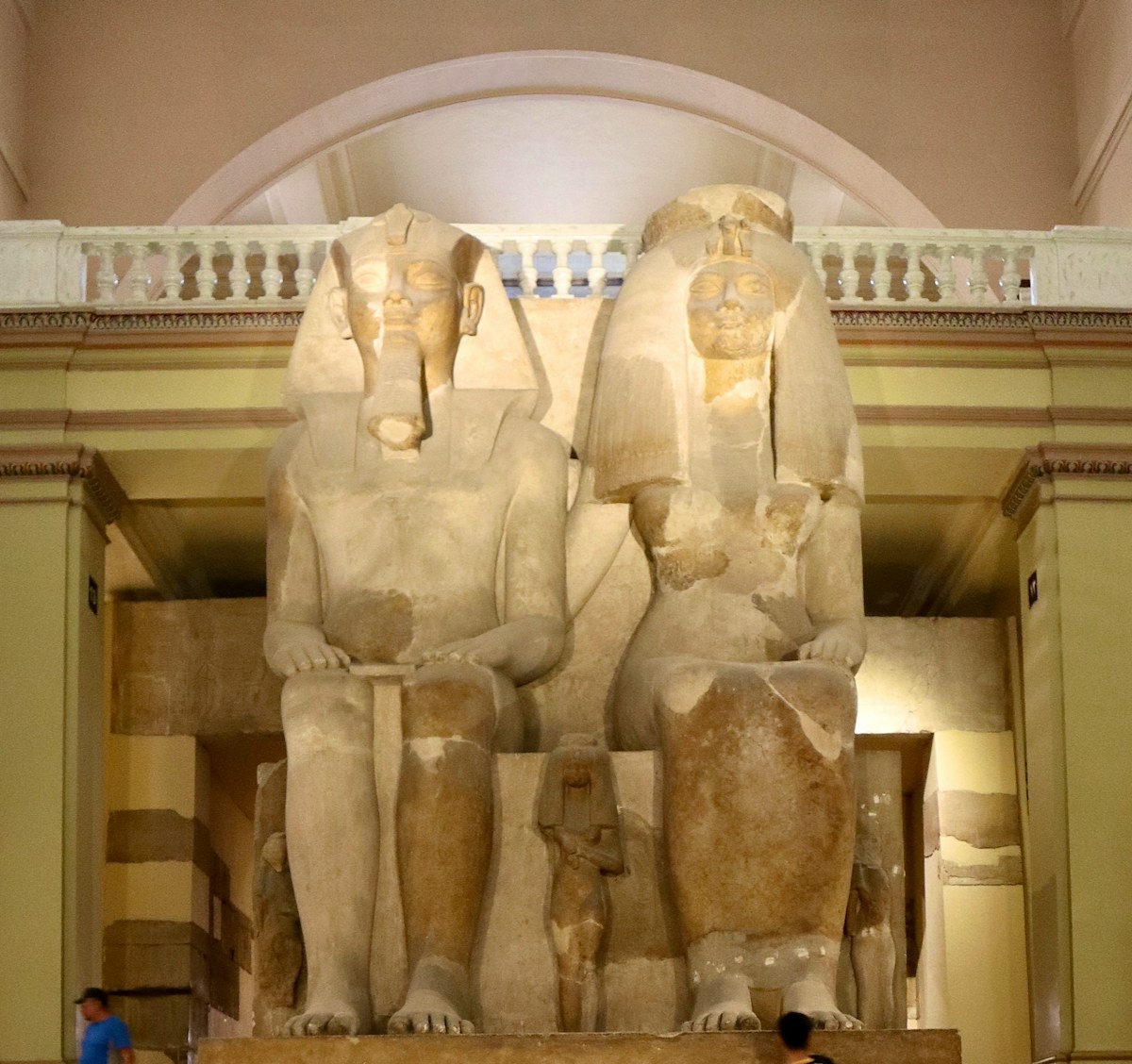
The ground-floor central atrium holds some of the museum’s most physically impressive pieces: colossal statues of Amenhotep III and Queen Tiye, seated statues of Ramesses II, and the massive quartzite sarcophagus of Marenptah. These need no introduction from a label - their scale does the work.
How Long to Spend
Minimum visit: 2 hours - covers Tutankhamun rooms, the Narmer Palette, and the atrium statuary. Recommended: 3 hours - adds the Royal Mummies Room and time to browse without rushing. Full visit: 4–5 hours - possible but exhausting. The museum has no café inside the main building; there are kiosks in the courtyard.
Best Time to Visit
October to April is the busiest period - the museum swells with tour groups between 10:00 am and 1:00 pm. Arriving at 9:00 am or after 3:00 pm gives you thinner crowds. Summer (June–August) is quieter tourist-wise, but Cairo heat is intense; the museum is not fully air-conditioned, and the upper floor can be stuffy by midday.
Avoid visiting on Egyptian national holidays - the museum can close or operate on restricted hours with no advance notice online.
How to Get There from Central Cairo
The museum is on the north side of Tahrir Square, roughly in the centre of the city.
- Metro: Sadat Station (Line 1 and Line 2 intersection) exits directly onto Tahrir Square. This is the fastest option from most central Cairo neighbourhoods. The museum entrance is a 3-minute walk from the station exit.
- Taxi / ride-share: Uber and Careem operate in Cairo. From Downtown Cairo, expect 10–20 minutes depending on traffic and a fare of approximately 30–60 EGP as of 2026.
- On foot: From the Nile Corniche or Downtown hotels, the museum is 10–20 minutes’ walk. The Tahrir Square area is straightforward to navigate on foot.
Note: There are persistent touts near the museum entrance who will tell you it’s closed or offer to take you somewhere better. It is not closed. Walk past them and buy your ticket at the official booth.
Practical Tips
- Check which Tutankhamun pieces are still at Tahrir before your visit - the GEM transfer was ongoing as of 2026, and the holdings may have changed.
- Wear comfortable shoes. The floors are hard marble and uneven in places; you will cover significant distance over two floors.
- Bring water. There are no water fountains inside the galleries.
- Hire a licensed guide at the gate if you want context - the museum’s labelling is sparse and inconsistent, and a good guide transforms the experience. Agree a price before starting (around $15–25 USD per hour for a two-hour tour is typical as of 2026).
- The GEM is not a replacement for Tahrir. If your itinerary allows, visit both - they hold different collections and have completely different atmospheres.
Historical Context
For deeper historical background on the Tutankhamun discovery, the royal mummies, and the building’s 1902 construction, read our Egyptian Museum history guide.